Wednesday, March 13, 2019

Humans Behaving Badly


Each summer Bill Gates picks a stack of books to take on a solitary retreat for a couple of weeks. When we lived on Whidbey Island, Bill’s annual hideout was just up the road from us, in a comfortable beach cottage on Steve Ballmer’s estate. 

Here’s a summary of Bill’s favorite books from the last few years. My current wait-list queue at Bellingham Public Library includes several of Bill’s recent recommendations, along with suggestions from the year-end reading lists published by the New York Times, Slate, Entertainment Weekly, and the University of Evansville's Provost.

My first two books from Bill Gates' list turned out to be polar opposites.


As you can see, Bill Gates provided a tepid blurb for Steven Pinker’s new book Enlightenment Now:  the Case for Reason, Science, Humanism, and Progress: “My new favorite book of all time.

Pinker, like Gates, is a congenital optimist. He’s not naïve – the first sentence of Enlightment Now acknowledges that the Trump era “would not seem to be an auspicious time to publish a book on the historical sweep of progress and its causes.” According to Pinker, Enlightenment ideals “are timeless, but they have never been more relevant than they are right now.” Pinker then goes on for 450 pages deploying statistics and other evidence to establish why these are the best of times. Cultural and technological improvements that began during the Enlightenment three centuries ago have brought dramatic improvements to every meaningful human measure:  life expectancy, health, nourishment, wealth, equality, freedom, happiness….

Pinker was motivated to write Enlightenment Now not by recent Trumpian developments, but rather by the reception to his 2011 book The Better Angels of Our Nature. In Better Angels, Pinker demonstrated that the impact of war, genocide, crime, and every other category of human violence has been steeply declining for decades, centuries, and even millennia. But Pinker was surprised how few critics and readers believed him. Fake News and poor math skills had turned everyone into a bunch of irrational pessimists.

Pinker acknowledges the “appeal of regressive ideas is perennial, and the case for reason, science, humanism, and progress always has to be made…  But there is no limit to the betterments we can attain if we continue to apply knowledge to enhance human flourishing.”

Humanism stresses the potential value and goodness of all human beings, emphasizes common human needs, and seeks rational ways of solving human problems. Humanist values should be part of any healthy worldview, whether you happen to be an atheist, materialist, agnostic, spiritual, or religious. 

Pinker himself is a prominent member of the “New Atheists” crowd, and can’t help criticizing anything he perceives as involving superstition. But his tone is not juvenile like Richard Dawkins, or snarky like Christopher Hitchens. Instead, Pinker’s basic message is “Gosh, aren’t humans neat?”


Yuval Noah Harari’s book Sapiens puts humans firmly in their place.

Life on Earth began 3.8 billion years go. Around 200 million years ago, evolution produced the first dinosaurs and mammals. Sixteen million years ago, our developmental branch within the Primate order diverged from the oranguatangs' path. A mere six million years ago, humans shared a common grandmother with our two closest primate cousins, chimpanzees and bonobos. The genus Homo eventually emerged four million later. (In the biological classification system, genus is the level above species.) Our species, Homo sapiens, finally appeared about 200,000 years ago.

As Harari is quick to point out, Homo sapiens aren’t very special, even within genus Homo. To the contrary, just 100,000 years ago we were one of at least six extant human species. Homo neanderthalensis had already been living in Europe and the Middle East for hundreds of thousands of years before the first Homo sapiens appeared in East Africa. 

Like the other Homos, we sacrificed useful traits like strength and speed in favor of disproportionately massive brains. Even though human brains only take up 2% of our body mass, they consume 25% of our energy. Other primates spend at most 8% of their energy powering comparably sized brains. Nevertheless, even after we tamed fire and invented a few stone tools, the human investment in big brains was hardly paying dividends. According to Harari, 

We assume that a large brain, the use of tools, superior learning abilities and complex social structures are huge advantages. But humans enjoyed all of these advantages for a full two million years during which they remained weak and marginal creatures… Genus Homo’s position in the food chain was, until quite recently, solidly in the middle.

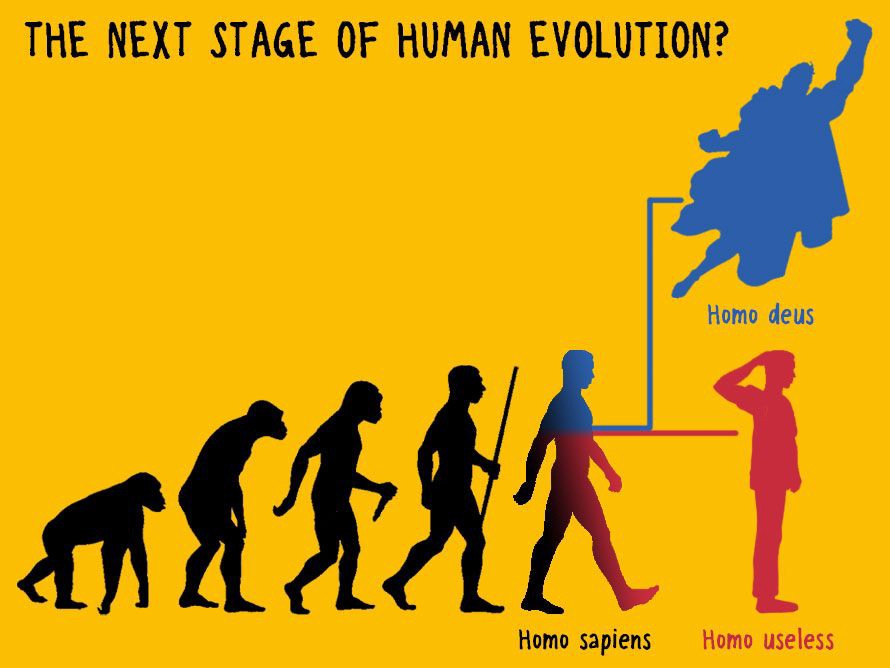
Our bodies, including our brains, were honed by competition with other species and within hunter-gatherer tribes for hundreds of thousands of generations. Harari argues that a major qualitative improvement in Homo sapiens’ brain capacity occurred very recently, about 75,000 years ago. He refers to this development as “The Cognitive Revolution.” Since then, there hasn’t been enough time for natural selection to accomplish further genetic evolution. Instead, our improved human brains are responsible for the havoc wrought by immense cultural evolution that continues at an ever-accelerating pace.  

Unlike other successful predators, such as lions, tyrannasaurus, and orcas, humans have only been at the top of the food chain for the evolutionary equivalent of the blink of an eye. Harari observes that in contrast with the gradual ascendence of other species, nature never had a chance “to develop checks and balances” for humans. Instead, we’re like evil young King Joffrey in Game of Thrones, handed a crown before we learned how to handle our anti-social urges.

As the writer Barbara Ehrenreich observes, we cannot comprehend human violence “without understanding that before they were warriors, or even hunters, our ancestors were the prey of more skillful and far better armed nonhuman predators.” As a result, Harari argues humans are terribly insecure – “like a banana republic dictator.”


I hope you're not too insulted by the comparison to King Joffrey. Even before you consider our recent role in climate change, humans already were the most successful perpetuators of genocide in global history (other than dinosaur-killing asteroids). 

After the Cognitive Revolution, Homo sapiens continued our simple hunter-gathering ways for tens of thousands of years. But we suddenly had a bigger footprint, and a broader range. After leaving East Africa, humans settled new continents like Australia and the Americas. Each time we promptly burned down forests and hunted all the local megafauna into extinction. Meanwhile, every other Homo species, including the Neanderthals, suspiciously disappeared. 


Twelve thousand years ago, humans decided to give up their hunter-gatherer lifestyle and settled down. Harari describes the Agricultural Revolution as "history’s biggest fraud.” 

Agriculture was good for certain plant species, such as wheat, corn, and rice. In Harari’s words, “These plants domesticated Homo sapiens, rather than vice versa.” A few animal parasites also exploited our domestication, like dogs, cats, and cockroaches. As Michael Pollan points out in The Botany of Desire, “there are fifty million dogs in America today, and only ten thousand wolves.”

Everyone else was a loser – from countless extinct species, to millions of chickens, hogs, and cattle living short miserable lives on industrial farms today, to the great mass of humanity who lived and died during most of recorded history. Hunter-gatherer tribes previously enjoyed nutritious diets, generous leisure time, and vibrant egalitarian communities. In contrast, agriculture’s “sivilizing” forces brought pestilence, over-crowding, crushing labor, patriarchy, poverty, and inequity. As evolutionary biologist Robert Saplosky observes, “When humans invented material inequality, they came up with a way of subjugating the low ranking like nothing ever before seen in the primate world.” As a species, we’re like family farmers who went deep into debt to buy some newfangled tractor long ago, and never recovered.

Harari’s book goes on to cast a similarly jaundiced eye on other human inventions like money, writing, religion, capitalism, empires, and science. Harari even lumps humanism in with Marxism and other destructive ideologies. According to Harari, everyone would have been much better off if humans had stuck with primitive animism or polytheism.

With most species, social network capacity closely correlates with the size of the social areas in the species' brains. Based on these calculations, both Harari and Sapolsky point out that the human brain was originally designed to interact with about 150 people. That’s how hunter-gatherers lived for innumerable millennia. 

Humans learned to enhance our brain power by offloading many tasks to tools like writing and technology. According to Harari, however, the real breakthrough occurred with the Cognitive Revolution. Evolutionary biologists characterize the revolutionary cognitive development that occurred around that time as human's capacity for “Theory of Mind.” This phrase comes from an influential 1978 paper by David Premack and Guy Woodruff, entitled “Does the chimpanzee have a theory of mind?” As far as we know, Homo sapiens is the only species with the ability to understand our experience and act based on the proposition that other individuals possess a mental state that may differ from our own

Harari focuses on one important aspect of Theory of Mind:  because each individual’s mental state is independent of the real world, humans can feel, believe, and foresee things that are not true and may never be. According to Harari, “large numbers of strangers can cooperate successfully by believing in common myths.” Harari uses the example of the car conglomerate “Peugot,” which exists as legal fiction separate from any real world person, automobile, factory, or brick-and-mortar bank. Other powerful communal fictions include capital, nations, Fortnite, and religion. (Remember that particular fictions may or may not turn out to be true.)

Humans’ collective fiction ability allows us to manage social relationships that extend far beyond a 150-person tribe. As Harari points out, sharing cultural memes allows us to make rapid, substantial changes to our species and to the world around us – without waiting around for natural selection to do its slow work at the gene level.

Other philosophers and scientists are less cynical than Harari. They focus on different aspects of the cognitive revolution that occurred when humans developed the capacity for Theory of Mind. For example, in his book Behave: The Biology of Humans at our Best and Worst, Sapolsky discusses the role of the brain’s Anterior Cingulate Cortex region. The ACC monitors our internal and external environments for any discrepancies with our expectations. A fully-developed ACC plays a key part in a uniquely human trait:  empathy.  Observing and understanding feelings – ourselves’ and others’ – is essential to our shared humanity.

So what happened when Homo sapiens finally evolved enough to share fictions and feel empathy?

Our brains grew three sizes. And our hearts. Now we just need to figure out how to solve some of the world's pressing problems together. Isn't that what being human is all about?


I’m no Bill Gates, but here's my list of the books I’ve read so far in 2019:

Leslie Jamison, The Recovering: Intoxication and its Aftermath

Susan Orleans, The Library Book

Emily Esfahani Smith, The Power of Meaning:  Crafting a Life that Matters

Barbara Eherenreich, Living with a Wild God: A Nonbeliever's Search for the Truth About Everything

Eric Idle, Always Look on the Bright Side of Life: A Sortabiography

Steven Pinker, Enlightenment Now:  the Case for Reason, Science, Humanism, and Progress

Christopher Hitchens, Hitch-22: A Memoir

Neil deGrasse Tyson, Astrophysics for People in a Hurry

Amy Chua, Political Tribes:  Group Instinct and the Fate of Nations

Lauren Weisberger, When Life Gives you Lululemons

Patton Oswalt, Silver Screen Fiend:  Learning about Life from an Addiction to Film

Edmund White, Inside a Pearl:  My Years in Paris

P.G. Wodehouse, Jeeves in the Offing

Craig Brown, Ninety-nine Glimpses of Princess Margaret

Jordan Ellenberg, How Not to Be Wrong: the Power of Mathematical Thinking

Adam Aptowitzer, Starting and Maintaining a Charity in Canada

William James, Varieties of Religious Experience

Sally Field, In Pieces: a Memoir

Yuval Noah Harari, Sapiens: a Brief History of Humankind

Judith Grisel, Never Enough:  the Neuroscience and Experience of Addiction

Anne Lamott, Almost Everything:  Notes on Hope

Viktor Frankl, Man’s Search for Meaning


Thursday, March 7, 2019

Organ Donor: The Movie


After waking up to an inch of snow this morning, all my children insisted on getting rides to school. Frankly my primary purpose these days is to chauffeur ungrateful people around town in a minivan. I might as well drive for Uber.

Last night I’d left my driver’s license in the car after showing it to the border agent on my way home from rehearsal with Vancouver Men’s Chorus. Eleanor grabbed it.

Eleanor:      I didn’t know you were an organ donor.

Papa:           Of course. I sign up whenever I renew my driver’s license.

Rosalind:     What’s an organ donor?

Papa:           It means that when I’m a terrible car accident on my way to someone’s volleyball game, the EMT will check my wallet to see if I’m an organ donor. Even if I’m brain dead, they’ll make sure to keep my blood pumping long enough to get me to the hospital.

Eleanor:      So they can “harvest his organs.”

Eleanor’s favorite TV show is Grey’s Anatomy. She wants to be a surgeon when she grows up. This week the girls registered for their high school freshman classes this fall. Eleanor signed up for “Medical Terminology.” I kid you not.

Papa:           In the TV movie version, the car wreck will happen just in time for Dr. Ken to get my kidney.

My friend Dr. Ken just got another kidney transplant. He’s already blown through two so far. No doubt he’ll be back on dialysis again before too long. It’s Dr. Ken’s riotous living. Or a childhood kidney disease.

Eleanor:      What about in the real-life version of the story?

Papa:           In real life it would never work. Dr. Ken has some kind of fussy blood type, so we're incompatible.

Eleanor:      Am I old enough to be an organ donor?

Papa:           Only if I’m the one doing the donating. 

Eleanor:      What do you mean?

Papa:           You’d have to be in the hospital in the coma or something, and they’d ask Daddy and me whether we want them to harvest you. Of course we’d say yes.

Eleanor:      Good.

Papa:           But in the TV movie version, the Lutherans would have some weird prohibition against organ transplants. And Daddy wouldn’t believe me when I said you wanted to be a donor.

Eleanor:      Millie Bobby Brown would play me in the TV movie.

Papa:           Who?

Eleanor:      [loud eye roll] From Stranger Things. 

Papa:           Now that Luke Perry is dead, I guess Cole Sprouse will have to play me.

Cole Sprouse is Eleanor’s celebrity crush. Yes, the same Cole Sprouse who was a Disney child star in Zack & Cody’s Suite Life. Eleanor would point out it’s also the same Cole Sprouse who played Ross’s son as a toddler in Friends. That’s her third favorite TV show.

Nowadays, Cole Sprouse plays an emo Jughead on The CW’s Riverdale. That's Eleanor’s second favorite TV show. Luke Perry played a steamy Archie’s earnest single dad oRiverdale.

Eleanor:      [another loud eye roll]  How would I become a donor?

Papa:           At the hospital they’d evaluate all your organs, and see if you’re a match with anyone on the recipient waiting list. In the TV movie, your ghost would come back to watch the surgery and bless all the recipients in a montage. 

                    But first there’d be a big courtroom scene. Rosalind would testify that she heard you say that you wanted to donate your spleen to your friend Malou.  Or Seneca, or Britten, or Naomi, I can’t keep track. 

Eleanor also loves TV shows with big courtroom scenes. Everyone says she should be a lawyer if she doesn’t go to medical school.

Papa:           In the movie Daddy would finally believe Rosalind, and everyone would cry. But in real life it could never happen. Rosalind is in the back seat listening to music with her earbuds and can’t hear us.

Rosalind:     I’m listening. I’ll remember to tell Daddy.


The actor and heartthrob Luke Perry died this week at age 52 after a stroke. I never watched Beverly Hills 20210, and wasn’t one of his fans. Before Riverdale, I think the last of Perry’s roles I remember was when he guest starred on the old Will & Grace as an ornithologist in clunky glasses. Jack described him as “the hot gay nerd - the rarest of all the gay subspecies."

However, I was always aware of Perry as one of the cohort of male actors who are all about my same age – Rob Lowe, Tom Cruise, Brad Pitt….  As you get older, it’s handy to have a wide selection of movie star dopplegangers to measure your decay against.

Now I will always remember Luke Perry with fondness because of a recent family moment, involving perhaps the nicest compliment I've ever received. My daughter Rosalind was watching Riverdale, and told me I’m just like Archie's father.

Papa:           You mean I remind you of the actor with the beard?

Rosalind:     No, the character.

Papa:           Because I'm a single dad?

Rosalind:     Yes. You're very wise, and you always put your kids first.


Wednesday, February 27, 2019

Unintended Consquences


Recently I dreamt I was watching the local news. Washington Attorney General Bob Ferguson, my former boss, was holding a press conference. Bob tearfully announced he was abandoning his 2020 gubernatorial campaign – because he and his photogenic family are moving to Bulgaria.

I’ve been trying to figure out what my dream means.


“Pro bono public” is a Latin phrase meaning “for the good of the public.” Regardless of their day jobs, attorneys are expected to contribute to their communities. Over your career you find different ways to serve as your interests and abilities change.

For young lawyers, representing pro bono clients is an important way to develop legal skills. 
When I started out in the 1990s as a baby lawyer in a big law firm, it was incredibly hard to get practical experience like depositions, trials, or oral argument. (No doubt it’s even harder today.) So I turned to the local bar association’s program for helping people with AIDS at the height of the epidemic. I also represented the court-appointed guardians of children in the foster system, an experience that proved useful years later as an adoptive parent. However, my favorite pro bono opportunities involved counseling ordinary folks at walk-in clinics. You’d meet someone new, learn about their problem, offer a little practical advice, then never have to worry about them again. The perfect clients.

My best friend at the law firm was less focused in his pro bono efforts, but found himself drawn towards consumer protection matters. If there’s anything a lawyer can do, it should include helping someone who’s been ripped off. Unfortunately, the law is a blunt instrument at the best of times.

Barbara’s story is about the worst of times.


I can’t remember the exact details, but the story goes something like this:

“Barbara” had taken her car into a random auto shop in Seattle for a simple procedure, costing less than $50. (It was the 1990s.) When she returned to pick up her car, she received a bill for hundreds of dollars’ worth of repairs. I don’t recall whether the mechanics fixed the wrong car, or merely billed Barbara for the wrong services. In any event, Repair Guy refused to give the car back until she paid the full amount.
            
When my lawyer friend heard Barbara’s story, he was outraged. Barbara was in the right. The record was unassailable. State statutes provided multiple remedies, but Barbara just wanted her car back. My friend assumed he could fix this problem with a lawyerly telephone call or “fax.” (It was the 1990s.)   

Repair Guy immediately made things more difficult by hiring a shyster lawyer. Of course, Repair Guy didn’t actually pay his lawyer, who soon disappeared. But not before creating a mess, running up a huge bill, and exhausting my friend’s pro bono tolerance. A bar complaint was probably involved. Eventually we were able to obtain some kind of court order, and Barbara got her car back. So far, the aggravation had only involved Barbara, Repair Guy, and their two unpaid lawyers. Plus me having to hear all about it.

Then my lawyer friend got a call a call from Barbara. Someone had poured acid on her parked car. The Seattle police easily linked Repair Guy to the crime. When a young prosecutor heard Barbara’s story, he was outraged. So he decided to go after Repair Guy. 

You never know when a simple pro bono matter is going to consume your life. In your mind, you’re Julia Roberts as Erin Brockovich speaking truth to power. In reality, each pro bono matter is a lottery ticket – it might take you to the Supreme Court, but more likely it will suck you into a black hole. 

Meanwhile, you’re desperately trying to avoid committing malpractice, while avoiding the partners at your law firm as they ask about your neglected pile of billable work. It’s the same at the prosecutor or defender’s office. As soon as you’re lured into some righteous crusade, everyone wants to know when you’re going to get back to doing your “real” job, whatever that is.

In Barbara’s case, Repair Guy drove both the prosecutor and his public defender crazy. He refused to consider any kind of plea bargain. He pretended not to speak English. The entire six-day jury trial was simultaneously translated into the language of whatever unmemorable Balkan country he’d immigrated from. It was a circus. The judge, jury, and lawyers were miserable. After a quick guilty verdict, Repair Guy was sentenced to a moderate jail sentence.

This was long before the horrors of Homeland Security and ICE (“Immigration & Customs Enforcement”), so I don’t how INS (“Immigration & Naturalization Services”) got involved. But when a young INS lawyer heard Barbara’s story, she was outraged. She grabbed Repair Guy’s file. Once again, some earnest new lawyer bit off a little more than she knew she could chew.

By the time I moved to Chicago in 1995, the repair business was gone. Barbara’s car had died. Repair Guy got out of jail, then was promptly deported. Meanwhile, my lawyer friend decided to focus his pro bono efforts on nonprofit board service.

None of this happened because one day Repair Guy made a simple mistake at work. It happened because he refused to take responsibility for his mistake, and instead insisted on making things worse – over and over and over again, with consequences no one ever anticipated.


I was thinking about Attorney General Bob Ferguson last month. I’d received a legal document on his letterhead from a young attorney in his office, responding to a routine procedural inquiry. No doubt this lawyer is very busy, with many more important things to worry about than my annoying correspondence. Still, you’d think she would bother to read the whole file before dashing off an indignant but inaccurate letter.

Not long ago, this kind of letter would have triggered an unhealthy reaction. As a codependent person, I would immediately assume I must be the one in error. As a person living with PTSD, my nerves would light up and make it impossible to work for a day or two.

Nowadays I just sigh and pour myself a cup of tea. I remember Hanlon’s Razor (“Never attribute to malice that which can be adequately explained by stupidity”). I remind myself most lawyers are too frantic to worry about anything other than the immediate task at hand. I realize everyone else is too busy to care about a few fibs or inconsistencies. As a result, this young hack lawyer thinks she can just make shit up and no one will notice.

Meanwhile, I’m sitting at home in my jammies, with all the time in the world to read and write about the Big Picture, and an exhaustive index of all the relevant documents. And lots of meditation tapes and herbal tea.

Still, I can’t help wondering why someone would write something under the Attorney General of Washington’s letterhead that they should know by now is demonstrably false. How many times will someone make the same mistake before they stop?

Hopefully this was the last time. I can dream, can’t I?


Tuesday, February 19, 2019

Three Evan Hansens


I’m still obsessed with the Broadway musical Dear Evan Hansen. Triple obsessed. Gay obsessed.


Ben Platt originated the role of Evan Hansen on Broadway in 2016. In fact, Platt played Evan in the show’s earliest staged reading in May 2014, and continued in each subsequent reading, workshop, and off-Broadway production. Along the way he won Obie, Drama League, and Tony awards. That’s Platt singing on the Broadway original cast album. For many fans, Ben Platt will always be the “real” Evan Hansen.

As I mentioned in my original post about Dear Evan Hansen, the play deals frankly with mental illness. I appreciated how the play didn’t get distracted with details about which characters might be diagnosed as anxious, depressed, or some other specific disorder. Instead, the playwright respectfully presents people in deep distress, regardless of its root causes.

Before the play opened, a New York Times profile discussed Platt’s role in developing Evan’s character:

In the show, Mr. Platt delivers a master class in the physicalization of adolescent discomfort. He twitches his eyes and his mouth, tugs on his sleeve, scratches a wrist, picks at a nail, grabs his back pockets, fidgets with a pencil. His voice is halting and soft, punctuated with doubt. 

According to Platt, “I thought back to a lot of kids in my high school who I think of as more socially awkward, or anxious, or worried about how they’re being perceived.”

Every actor brings something different to a role. As a connoisseur of anxiety and alienation, I can attest that Platt perfectly captures the tics and pangs of social anxiety.


Taylor Trensch took over as Evan on Broadway in January 2018.  

Replacing the original lead in a Broadway musical can be a dicey proposition. Many shows don’t even try to survive a star’s departure. (Yes, Yogi, I saw Julie Andrews in Victor, Victoria). Other musicals try to get away with the temporary gimmick of casting an expensive Hollywood star.

A mega-successful Broadway cash cow need to pace itself for the long haul. One approach is to bring in an unfamous but supremely talented performer, and hope for the best. For example, the brilliant Megan Hilty took over for Kristin Chenoweth as Glinda in the Broadway production of Wicked

Similarly, both official Dear Evan Hansen videos as well as YouTube bootlegs demonstrate that Trensch is an excellent singer and actor. As the New York Times observed in its re-review, the result is a less overpowering and more balanced play. 

Trensch also brings a different approach to Evan’s alienation. As one of my theater buds put it, “he’s definitely on the Asperger’s spectrum.”


The producers of a Broadway phenomenon’s first national touring cast face a similar casting challenge. Do you lure an alumnus from New York?  Bring in a celebrity? Or find a newcomer brimming with raw talent?  

After some obsessive YouTube stalking, it’s clear that Ben Levi Ross, the Evan Hansen on tour, brings a lot of power to the role. In contrast with Platt and Trensch, Ross portrays Evan’s alienation from the perspective of a skinny nerd outsider. Or maybe it’s just the Jewish name and clunky glasses.

One of the key differences between the Broadway and touring experience is the variety of venues. Instead of settling into a permanent home, the actors need to be prepared for all kinds of spaces. I recently saw Dear Evan Hansen in Seattle’s vast Paramount Theater, which sold out all 2,807 seats. That’s almost three times as many as Broadway’s Music Box Theater. Frankly it could have been anyone down there in the striped shirt and arm cast. But he definitely had an amazing voice.


The only gay references in Dear Evan Hansen come in Eleanor’s current favorite song, “Sincerely Me.” 

As the play begins, we learn that Evan Hansen’s therapist suggested Evan use journal writing to help him work through his issues. Evan’s assignment is to write affirming letters to himself, which begin “Dear Evan Hansen….” Connor picks up one of Evan’s letters from the printer at school. The letter is found in his pocket after Connor kills himself, resulting in the confusion and temptation that propels the drama.

Desperate to comfort Connor Murphy’s grieving mother, Evan conspires with a geeky classmate to forge emails documenting a faux friendship between Evan and Connor. As they type, the actor who played Connor in the opening scenes returns from the grave to exuberantly sing along.

Evan and Connor’s imaginary friendship develops through the song “Sincerely Me.” The boys get a little carried away. The geeky friend throws in a little innuendo. Hence the panicky gay reference:

CONNOR
DEAR EVAN HANSEN: 
THANKS FOR EV’RY NOTE YOU SEND 

EVAN
DEAR CONNOR MURPHY:
I’M JUST GLAD TO BE YOUR FRIEND 

EVAN/CONNOR
OUR FRIENDSHIP GOES BEYOND YOUR AV’RAGE KIND OF BOND 

EVAN
BUT NOT BECAUSE WE’RE GAY 

CONNOR
NO, NOT BECAUSE WE’RE GAY 

EVAN/CONNOR
WE’RE CLOSE, BUT NOT THAT WAY 
THE ONLY MAN
THAT I LOVE
IS MY DAD 

Songwriters: Benj Pasek / Justin Paul
Lyrics © Kobalt Music Publishing Ltd


After finally leaving the cast of Dear Evan Hansen, Ben Platt spent last year writing songs and working on an album that comes out next month. 

So far Platt has released a couple of songs. He used the occasion of his second video, “Ease My Mind,” to come out of the closet in People magazine. 

Apparently the songs on the upcoming album explore Platt’s experiences with gay love. He hasn't revealed enough material yet to determine whether we’re in the same relationship territory as Adele, Taylor Swift, or Alanis Morrisette.

The hunky eye candy in Platt’s video is fellow out Broadway performer Charlie Carver. He’s the youngest of the openly gay actors who recently appeared in a high profile revival of The Boys in the Band, along with Matt Bomer, Jim Parsons, Zachary Quinto, and Andrew Rannells.


One of my favorite songs from Dear Evan Hansen is “Only Us.” 

The play begins with Evan nursing a secret crush on Zoe Murphy. They finally get to know each after her brother Connor kills himself. Zoe and Evan sing “Only Us” as they try to carve out space for their fragile relationship.

As I mentioned in an earlier fanboy blog post, Trensch and Ross are not just openly gay, they’re also an adorable couple. Soon after wrapping up his Broadway run as Evan, Trensch met up with Ross on the road with the Dear Evan Hansen tourWhile in Seattle this month they found time to record and film a video of “Only Us.” Here’s a YouTube link to their charming same-sex Valentine Day’s duet. 


What are the odds that the first three actors to play an iconic straight role would all happen to be openly gay?

For one thing, the odds are a lot higher than they used to be. More people everywhere, including actors, are open about their sexual orientation. They’re also comfortable with coming out at a younger age. Platt, Trensch, and Ross are part of the most the most LGBT-affirming generation ever. According to some surveys, up to 20 percent of millennials identify as members of the LGBTQ community.

Percentage of Americans responding affirmatively to the question 
"Do you personally identify as lesbian, gay, bisexual, or transgender?"

Nevertheless, as I wrote last year in “Tuning Your Gaydar,” it’s notoriously difficult to collect reliable demographic information about sexual orientation. So let’s use a conservative estimate, such as assuming 4 percent of American men in their 20s identify as gay. That’s 1 in 25. If we pick from a random sample before we started casting three Evans, here’s how to crunch the probability numbers:


That’s similar to the odds that a random American speaks Cherokee. Or that you’ll be murdered. (There's a website for this, I looked them up.)


As Barbie notoriously observed, “Math is hard.” 

Actually I think Barbie meant arithmetic is hard. (Fortunately our phones all come with calculators.) Mathematics is amazing. It’s also complicated.

In this case, before getting carried away with our probability computations, we need to consider what else our trio of gay 20somethings might have in common, other than being the first three actors to play Evan Hansen. Do we really have a representative sample of all 20something American males? Was their selection by the producers truly independent of each other?

I’m not ready to publish my statistical analysis yet. But I bet it says something about Broadway musicals and the people who love them.


More responses to Dear Evan Hansen:

   "Dear Evan Hansen" (1/29/19)
   "The Shelf Life of Metaphor" (1/31/19)
   "Another Dear Evan Hansen Update" (2/3/19)
   "Confabulation" (2/27/20)


Sunday, February 3, 2019

Another Dear Evan Hansen Update


I’m still completely obsessed.

As I wrote in my original response to seeing Dear Evan Hansen last weekend, I went into the performance blind. Despite hanging out with so many theater queens, I intentionally avoided any spoilers. My blank slate approach amplified an intensely emotional experience. Watching the story unfold in real time with my daughter also enhanced my appreciation of Dear Evan Hansen as a smartly constructed exemplar of theater’s and Broadway’s continuing power. 

After seeing Dear Evan Hansen a week ago, however, I may have overcompensated for my prior embargo on spoilers. I’ve now listened to the original cast album on repeat enough to memorize all the lyrics and chord progressions. I’ve watched bootleg videos on YouTube and compared various casts. I've read numerous reviews and analyses. And I’ve already published three blog posts about the musical.   

I haven’t stalked anybody yet. But yesterday my friend and fellow Broadway obsessive Dr. Ken sent me the following Instagram picture. It shows the two actors who played Evan Hansen in New York and on tour this year. Apparently they’re now dating, and too adorable for words.


Other than Dr. Ken's sleuthing, so far the most interesting thing I’ve discovered in my post-play Dear Evan Hansen research is an eerily similar response from another critic.

Over the last few years The New York Times has published numerous articles about Dear Evan Hansen, from the play’s workshop and off-Broadway beginnings, up to the current national phenomenon. Ben Platt, the dorky actor you sorta remember from Pitch Perfect, originated the role of Evan. That's him you hear on the original cast album. And in your head.

A year ago, the Times’ junior theater critic Jesse Green got the assignment of re-reviewing the Broadway production after Platt’s departure. Under the headline “ ‘Dear Evan Hansen’ has a New Evan, and a New Balance,” here's how Green begins:

Everything is the same. And everything is different.

And then again, everything is the same.

Yes, “Dear Evan Hansen,” which officially introduced Taylor Trensch as its new Evan on Thursday, is still a gut-punching, breathtaking knockout of a musical. But it is differently gut-punching and breathtaking now than it was during the year that Ben Platt led the cast.  …  With Mr. Trensch’s Evan less dominating, the weight of the story is more evenly distributed among its eight characters. 

Green’s observations make sense. However, it was the critic's very personal conclusion that resonated most with me. In fact, Green's ultimate response to Dear Evan Hansen parallels my own recent blog essay about how parenthood is at the center of the play:

When Evan tries to comfort the family of Connor, a schoolmate who has committed suicide, their need for information gets tangled with his need to be noticed and a moral nightmare ensues. Also a practical nightmare, as the lies he tells, amplified by social media, return to haunt him. These are big issues…. 

Ill-considered though it may be, Evan’s attempt to fill the void left behind by Connor, and the void in his own heart, feels affectingly truthful. Even so, and despite the intensity of interest in the title role, “Dear Evan Hansen” remains — for this father, anyway — most moving as the story of two mothers. Connor’s (Jennifer Laura Thompson) is naturally crushed by the death of her son. Evan’s (Rachel Bay Jones) tirelessly enacts the role of cheerleader-in-chief for her lonely, awkward boy. But both are also dealing with something I suspect every parent in the audience understands: their terrifying responsibility for the happiness of their children, coupled with their marginal ability to do anything about it. When Ms. Jones sang the song “So Big/So Small” near the end of the show on Tuesday, there wasn’t a dry eye in my face.


Years ago, I gave up my pursuit of a literature PhD because I was worried there were no jobs out there, and nothing left for anyone to say. 

Both conclusions remain true, more or less. Indeed, my pessimism was further confirmed this week as I binged on repetitive Dear Evan Hansen criticism at the same time as I unsuccessfully applied for more jobs.  

Fortunately, I’ve finally faced my Post-Traumatic Stress Disorderwriter’s block, and codependency. Now nothing stops me from writing. More or less.


More responses to Dear Evan Hansen:

   "Dear Evan Hansen" (1/29/19)
   "The Shelf Life of Metaphor" (1/31/19)
   "Three Evan Hansens" (2/19/19)
   "Confabulation" (2/27/20)