Showing posts with label Hope. Show all posts

Sunday, May 4, 2025

The Boys Who Lived

Vancouver Men’s Chorus is busy rehearsing for our June concerts. (Tickets are on sale at the chorus website.) This year’s theme is Totally Awesome ’80s. We will be singing songs by Cyndy Lauper, George Michael, Eurythmics, Madonna, Tina Turner, Erasure, Pet Shop Boys, Whitney Houston, and more. There will be synthesizers, dancing boys, and big hair. 

I spent the 1980s as a clueless high school student in small town Utah; as an earnest Mormon missionary in Korea; as an overachieving student at Brigham Young University; and as a liberated law student at Yale. I’m like an episode of Stranger Things – 80s music is the soundtrack of my youth. 

More than music and mullets, my relationship with the 80s is defined by one essential fact: I came out of the closet in the middle of the AIDS epidemic. 

I recently read a collection of essays with the title Between Certain Death and a Possible Future:  Queer Writing on Growing Up with the AIDS Crisis. These writers speak for my generation:

Every queer person lives with the trauma of AIDS, and this plays out intergenerationally. Usually we hear about two generations - the first, coming of age in the era of gay liberation, and then watching entire circles of friends die of a mysterious illness as the government did nothing to intervene. And now we hear about younger people growing up with effective treatment and prevention available, unable to comprehend the magnitude of the loss. But there is another generation between these two, one that came of age in the midst of the epidemic with the belief that desire intrinsically led to death, and internalized this trauma as part of becoming queer.

I arrived too late for the fun. Instead, I threw myself into activism. I joined the ACLU of Illinois as Director of the LGBT Rights/AIDS Project at the height of the AIDS epidemic. The Project’s founder, John Hammell, had recently died. Many other pioneering Baby Boomer gay activists were dead, dying, and/or burnt out. Stalwart lesbians and unprepared young gay men filled their empty shoes. 

Some people see personality types through the prism of birth order. As the first of four brothers, I exhibit many “eldest child” behaviors. But when it comes to my gay tribe, I’m part of very specific cohort:  the traumatized gay boys of Generation X, stumbling through life as perpetual younger brothers to the men of the Stonewall Generation. 

This photo of San Francisco Gay Men’s Chorus was taken in 1993, twelve years into the AIDS epidemic. The seven men in white are the original members of the chorus. The 115 men in black represent those who had already died. 

Trauma warps memory. As I learn to live with complex PTSD, I’ve discovered a handful of revealin gaps and glitches in my recollection of past events.   

For example, the quietest moment in our 80s concert occurs during “Eulogy.” Seattle Men’s Chorus commissioned this song in 1985. I have sung and heard “Eulogy” countless times since I joined my first gay chorus three decades ago, including at various memorial services. I’ve repeatedly listened to SMC perform “Eulogy” on their classic Pink Album

Nevertheless, I have no memory of the song. All I can tell you is that it repeates the word “Onward.” Every time VMC rehearses “Eulogy,” I feel like I’m sight-reading a shocking new testament of grief. By the end of the song I’m silently weeping.


Many of the boys died.

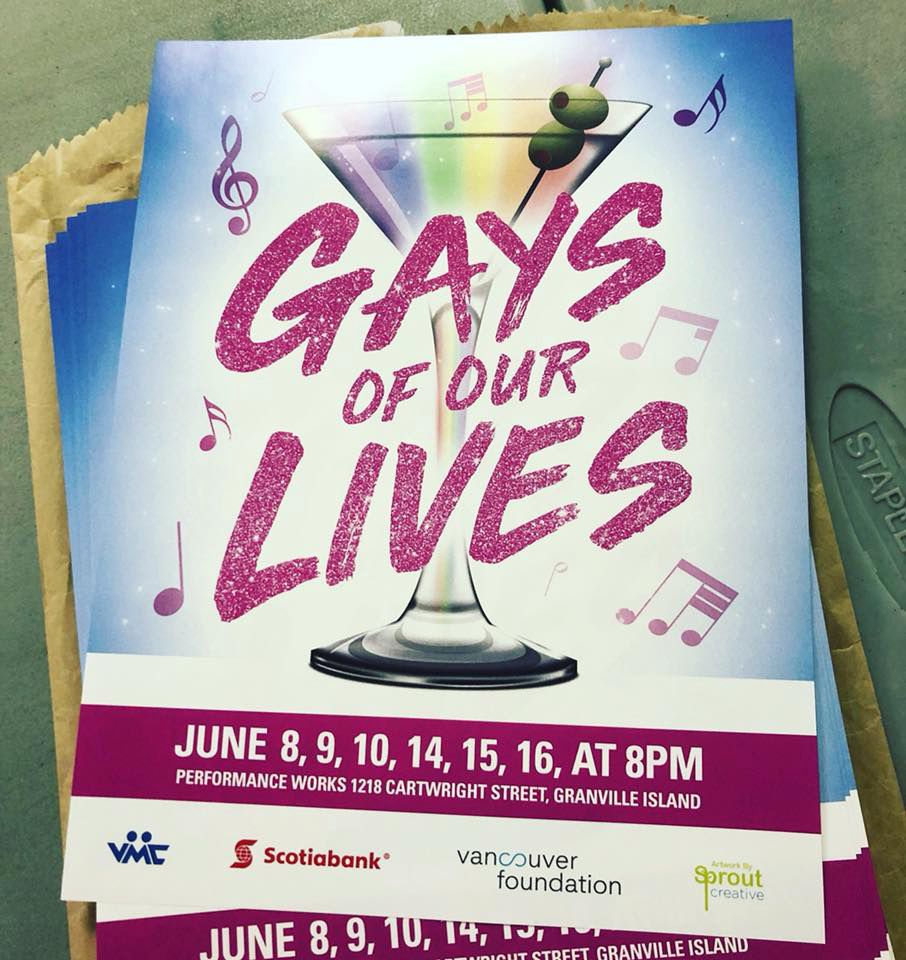
The theme of VMC’s June 2018 concert was Gays of Our Lives. As we read through “I Shall Miss Loving You” at our first rehearsal, I realized the last time I’d sung the song was eighteen years before, at my friend Jim Palmer’s memorial. We sang together in Windy City Gay Chorus during the 90s. The miraculous new HIV/AIDS medications came along too late to stop the disease’s progress through Jim’s body. Still, he wanted to see the new millennium. He barely made it. 

I was thirty-five years old. Jim was thirty. I weep every time I try to sing these words:

I shall miss loving you.
I shall miss the comfort of your embrace….

I shall miss the joy of your comings,
And pain of your goings, and, 
After a time,
I shall miss loving you.

Boys like Jim died from AIDS, suicide, drugs, and other causes. Somehow, some of us survived to tell the stories. 

In September 1914, soon after Britain suffered the first casualties of the Great War, Lawrence Binyon published “For the Fallen.” The poem’s fourth stanza has become known as the “Ode to Remembrance”:

They shall grow not old, as we that are left grow old: 
Age shall not weary them, nor the years condemn.
At the going down of the sun and in the morning
We will remember them.

Some of the men lived.

In 1981, a pioneering national tour by San Francisco Gay Men’s Chorus inspired gay choruses to form in cities including Chicago, New York, Seattle, and Vancouver. Forty-four years later, our founder Willi Zwozdesky still conducts Vancouver Men’s Chorus. Willi is the senior conductor in the LGBT choral movement.

VMC has never sounded better. We continue to attract talented new singers. At our recent rustic retreat, Millennials and Gen Y gay boys joined in the skits, rehearsals, and comradery. We listened to our elders around the campfire, and serenaded our conductor with his favourite song.  Along with Willi, a handful of other survivors have held the chorus and the community together through five extraordinary decades.

I am growing old. But the men of the Stonewall generation will always be older than me.


Monday, January 9, 2023

Starting Over


For New Year’s, we had the highest tides I’ve ever seen in Bellingham. For Christmas, we were snowed in by a freak ice storm. For solstice, I was trapped at home with covid. 


After a long hard year, Bear and I found ourselves surrounded by gloom and doom. But the end is finally in sight.


Hope comes more easily in springtime. Five and a half years ago, in May 2017, I emerged from the fog of PTSD and embarked on a couple of hopeful adventures. 


First, I filed a lawsuit against Ogden Murphy Wallace, PLLC. They’re the supposedly “independent” private investigators the State’s lawyers used to justify firing me from my position as general counsel to Western Washington University. Despite the impact of living with PTSD, I thought the Ogden Murphy Wallace lawsuit would let me use my legal skills to clear my professional reputation and protect my family.


Second, I started publishing essays on this blog. In Phase I of blogging, covering posts in 2017 and 2018, I took advantage of my newfound freedom from thirty years of writer’s block by exploring a variety of topics and styles. My favorite essays about family were “I Come From Good People” and “Sure of You.” My favorite essay about brains was “Inside Out.” My favourite essay about Showtune Night in Canada was “Six Degrees of Kristin Chenowith.” Thanks to the mysteries of Google’s algorithm, the three most viewed blog posts were “About My Yale Classmate Brett Kavanaugh,” “Thing 1 and Thing 2,” and “Fifty Shades of Green Gables.”


Phase II covered posts in 2019 and 2020. I got more ambitious about extended storytelling and the craft of writing. I published a week of “Rock Bottom Stories,” as well as other connected essays about topics like my dramatically improved mental health, various besetting plagues, and the comforts of dog ownership. For the first time I confronted my experiences as a gay man coming out of the closet at the height of the AIDS epidemic. And I wrote about the traumas and triggers I’d experienced while trying to shine a spotlight on dishonest government lawyers. 

Frankly I got carried away with that last topic. Sleazy lawyer stories were taking over the blog, like an oversized moon whose gravitational pull turns ordinary tides into tsunamis. When I looked at the statistics for 2020 I was aghast. I vowed I wouldnt start Phase III until I freed myself from the power of the Lawyer dark side. 

Over the last couple of years, most of my writing ended up in other places besides this blog. But I’m proud of the essays I published here as well, including deeper explorations of community, family, memory, and mental illness. By joining The Narrative Project, I learned about the craft of writing, story-telling through trauma, and finding a writer’s life and community. I assigned myself a graduate reading list in psychology and neuroscience. And I observed my thoughts and feelings through hours of mindfulness and loving kindness meditation. 


Along the way, I slowly learned to clear my head. I’m still oblivious to lots of important things, starting with everything social, particularly with the gays. But eventually I learned to think clearly by thinking like a writer, not a lawyer – at least, not like the kind of lawyer Attorney General Bob Ferguson would hire.


In November 2017, King County Superior Court Judge John Ruhl dismissed my claim against Ogden Murphy Wallace on a legal technicality.


It was important technicality. Washington law immunizes whistleblowers from liability for claims based on their communications to government agencies. One of the questions before the court in my case was whether whistleblower immunity applies to paid communications by government contractors, like Ogden Murphy Wallace’s supposedly “independent” investigation report attacking my character and competence. In August 2021, the Washington Supreme Court ruled that government contractors can’t be sued for injuries that are “directly based” on communications like the Ogden Murphy investigation report. 


Our busy trial judge was so focused on the whistleblower statute that he overlooked my other claims against Ogden Murphy Wallace – the ones that weren’t based on any protected whistleblower communication, such as the investigators’ repeated lies about their contractual assignment. Unfortunately, everyone else in the legal process was also distracted by the shiny statutory construction bauble. I spent the next few years trapped in a Kafka-esque struggle to find a state tribunal that was interested in hearing how the State’s lawyers and investigators colluded in government contract procurement fraud, civil rights violations, and ongoing acts of concealment and obstruction. 


After losing my state court claim against the OMW Defendants in the trial court, then winning, then losing, then winning, then losing, I lost my original lawsuit for good in June 2022 when the Washington Supreme Court declined further review.


The most interesting event in my state court lawsuit occurred on October 20, 2017. The day before my response was due to Ogden Murphy Wallace’s whistleblower immunity motion, the defendants produced a suspicious document related to their investigation:  the only surviving copy of the 3/16/16 “Investigation Scope Email” from Ogden Murphy investigator Patrick Pearce to the State’s employment attorneys. This smoking gun email revealed I was the victim of a wrongful termination cover-up scheme involving senior lawyers at the AGO, including some of Bob Ferguson’s top lieutenants.


While my original lawsuit against Ogden Murphy wound its way through its doomed appeal, I began tracking down additional incriminating evidence through Public Records Act requests and administrative complaints. Unlike Ogden Murphy, I’m an actual whistleblower. Meanwhile, the State and its co-conspirators continued to execute their strategy of stonewalling, gaslighting, and spoliation.


The State refused to respond to my notice of claim and mediation invitation, and threated to sue me instead. So in April 2020, I filed another lawsuit in state court, this one against the Attorney General’s Office, the Governor’s Office, Western Washington University, and their corrupt employees. I was shocked when the State Defendants chose to remove all of my damage claims to federal court. I felt like Br’er Rabbit being thrown into the briar patch. Before I tried to repackage myself as an appellate lawyer and judicial candidate a few years ago, I spent two decades managing complex federal litigation at Bogle & Gates, the ACLU, and Davis Wright Tremaine. I’m much more comfortable litigating in federal rather than in state court.


However, it turned out removal was just another short-sighted stall tactic by the State’s lawyers. I didn’t realize cases in the Western District of Washington were paralyzed because our court had the most vacancies of any federal court in the country. After the rest of the baby boomer judges all retired, Judge Richard Jones and Judge Ricardo Martinez held down the fort alone for several years. Our Washington senators and the local legal community succeeding in preventing Donald Trump from making any judicial appointments to fill the vacancies. My lawsuit against the State slowed to a crawl as unfortunate collateral damage. We didn’t even have a trial date or a case schedule.


Once several Biden judges were confirmed, however, the federal court finally returned to a normal litigation schedule. The two-year delay gave me enough time to improve my mental health and to gather a mountain of incriminating evidence. On September 23, 2021, Judge Jones denied the State Defendants’ long-delayed motion to dismiss my claims. Instead, the judge granted my motion to file a detailed amended complaint that includes new damage claims against Ogden Murphy Wallace as well as against the Attorney General’s Office, the Governor’s Office, WWU, and their employees. 


It’s as if all the frustrations of my original state court lawsuit never happened. Now we’re on a regular federal court litigation schedule. This month we’re waiting for Judge Jones rulings on the State Defendants’ frivolous Third Motion to Dismiss (here’s my response and their reply) and the Ogden Murphy Wallace Defendants’ motion to dismiss some of my new claims (here’s my response and their reply). Depositions in the Federal Lawsuit are scheduled to begin in February, with a jury trial set for January 2024 in Seattle.


I billed more hours of legal work in 2022 than any year since I was a young litigation associate – plus walking at least six miles a day with Bear to keep my head clear. I also had oral arguments in at least ten court hearings in 2022, which sets a personal record. The hearings were all in my Public Records Act case in state court, which is set for a bench trial before Judge Mary Sue Wilson on February 6-7, 2023, in Thurston County Superior Court. 


In 1972, Washington voters enacted the most transparent government accountability law in the nation. I’ve submitted dozens of requests to state and local agencies under the Public Records Act. With the sole exception of the Office of the Governor, each agency acknowledged my PRA requests within five days as required by the statute. In October 2020, I emailed the three public record requests to the Office of the Governor as directed by its webpage. The State’s email servers diverted my emails as “junk.” About the same time, the same thing happened with my emails to addressees at several other government agencies – apparently someone put my name and website on some kind of internet “no-fly” list. 


Sadly for the Governor’s Office, the Assistant Attorney General assigned to communicate with me on behalf of the State has a bad habit of ignoring my emails, regardless of whether they end up in his inbox or his junk folder. By the time his clients and his supervisors realized their lawyer dropped the ball, they’d already incurred millions of dollars in potential statutory penalties by delaying the Governor’s response to my public records requests for over a year.


Once again, the State and its lawyers refused to take responsibility, instead blaming me for their communication errors. So I filed a separate Public Records Act lawsuit against the Governor’s Office. We’re scheduled for a two-day bench trial in Olympia in February. Here’s my lawyer’s Opening Trial Brief.


In August 2021, the world seemed to be approaching the end of the covid pandemic. The Canadian border finally reopened, at least to visitors who uploaded their vaccination status and recent negative test results to an app. Vancouver Men’s Chorus began rehearsing, but only masked and in limited numbers. 


We also seemed to be approaching the end of my lawsuits against the State and Ogden Murphy Wallace. In the federal lawsuit, Judge Jones recognized my disability and granted the reasonable accommodation I requested. In my original state lawsuit, the Washington Supreme Court rejected Ogden Murphy Wallace’s claim that lawyers are above the law. 


However, we were actually far from the end – both with the coronavirus pandemic and with my efforts to hold the State and its lawyers accountable. It wasn’t even the beginning of the end. But as Winston Churchill would say, we finally reached the end of the beginning.


In 2021, two longtime members of Vancouver Men’s Chorus commissioned a new work by our resident accompanist and composer Dr. Stephen Smith. They wanted a song that would express the hope and joy the choir felt when we were finally able to sing together again after eighteen months of pandemic isolation and silence. Stephen chose to set to music an 1899 poem by Thomas Hardy. Hardy was one of those gloomy Victorian who looked at the bleak modern world and sighed, yet somehow managed to find hope. 


The original title of “The Darkling Thrush” was “The Century’s End.” Stephen arranged the four stanzas as a unison chant, then a two-part duet, then a trio, then with all four sections of the chorus in full harmony. Hardy’s poem begins in desolate twilight, with a storm approaching as “every spirt upon earth seemed fervourless as I.” Suddenly “a voice arose among the bleak twigs.” An ancient song thrush “chose to fling his soul upon the growing gloom.” In Stephen’s arrangement, the thrush’s song is a fiddler’s reel. In the wild, the male thrush uses his distinctive song to attract a mate in the dark.


In the folklore of the English countryside, the thrush is known as the bird who sings in the darkest hour. At the conclusion of Hardy’s poem, the narrator recognizes “there trembled through his happy good-night air / Some blessed Hope, whereof he knew / And I was unaware.” 


Even when the days get shorter and the nights get darker, we know the light will return. Let us begin the new year in kindness and hope.


March 2023 litigation update:


My lawsuit asserting claims against the Office of the Governor under the Public Records Act was set for trial on Monday, February 2, 2023. However, on the Friday before trial we learned we'd lost our slot to a three-week jury trial involving bull-goring injuries and cattle prod experts. Instead, we held our two-day bench trial on May 1-2, 2023. Closing arguments are scheduled for May 25, 2023.


Sunday, December 18, 2022

Typhoid Merry


I almost got to be a super-spreader. 


Instead, I’m isolating in my room with Bear – the first in our family to test positive for covid despite all the social distancing, masks, vaccinations, and dodged bullets. 


I got covid without even noticing it. When Bear and I got home from our usual long walk Wednesday afternoon, I had an email from someone who attended the same festive gathering in Vancouver on Sunday. After feeling a little under weather for a couple of days, he failed a home covid test. He suggested we all check our coronavirus status. Most attendees promptly reported negative results – other than an unlucky few. 


I’d taken so many covid tests before. This time I squeezed four drops into the plastic well, then watched the bright red line instantly light up. 


After observing so much suffering during the pandemic, my own experience with covid has been blessedly anticlimactic. Ive had no symptoms. The kids all stayed virus-free as we finished the last week of school. 


However, the December schedule is a mess. And I’m still trapped in “isolation”:  staying at home except for long walks in the woods with Bear; letting the kids feed themselves as the dishes pile up; and either wearing a mask as I try to get work done at my desk, or hiding in my bedroom while Christmas music plays on an infinite loop. 


Before the covid surprise, I was planning to drive back up to Vancouver on Wednesday night to attend a holiday sing-along event hosted by friends at a club downtown. According to the CDC chatbot’s calculations, Wednesday was my most infectious day. 


Ironically, I’d already decided to skip the Xmas sing-along and save myself for a New Years trip. Instead, I told the kids I was loopy on Theraflu. I hadnt actually taken any. I just wanted to cover up my decision to take the day off, stay home, and do edibles while pretending to be sick. Still, I’m glad I checked my email before I changed my mind about heading to the piano bar. My boisterous caroling would have contaminated numerous unsuspecting revelers with aerosolized coronavirus.


Instead I’m in isolation for ten days. Blame Canada.


This is what covid looks like (Xmas 2022)


Thursday, September 1, 2022

Relabeling


I met my best friend Paul in 1970 on the first day of Grade 1. Like my best friends in high school, college, and law school, Paul turned out to be gay. (Apparently I’m contagious.) 


Paul also turned out to be mentally ill. After struggling with depression, anxiety, and other challenges, Paul killed himself twenty years ago.


I thought of my friend Paul while reading the first chapter of Stephanie Foo’s recent memoir. A few months before he died, Paul told me he felt betrayed by his healthcare providers. While peeking at his medical charts, he discovered he had Borderline Personality Disorder, a bleak diagnosis that was even bleaker two decades ago. No one bothered to tell Paul, which made it even worse.


In What My Bones Know: A Memoir of Healing from Complex Trauma, Foo writes about growing up in San Jose with dysfunctional immigrant parents who subjected her to relentless physical and emotional abuse before abandoning her as a teenager. Foo escaped to college, found an effective therapist, and went on to a successful career in Bay Area public radio. Eventually Foo moved to New York to work as a producer at This American Life, the granddaddy of podcasts. 


Nevertheless, Foo found herself increasingly frustrated with challenges at work and in her relationships. At age thirty she was still seeing the same therapist, now via Zoom. Eventually she asked “Do you think Im bipolar?”


Samantha actually laughs. “You are not bipolar. I am sure of it.” she says. And that’s when she asks, “Do you want to know your diagnosis?”

I don’t yell, “Lady, I've been seeing you for a fucking decade, yes I want to know my goddamn diagnosis,” because Samantha taught me about appropriate communication. Thanks, Samantha. Instead, I say, “Yes. Of course.”

Something in her jaw becomes determined, and her gaze is direct. “You have complex PTSD from your childhood, and it manifests as persistent depression and anxiety. There’s no way someone with your background couldn’t have it,” she says.

“Oh. Yeah, PTSD.” Post-traumatic stress disorder. I had a crappy childhood, so I kinda figured that.

“Not just PTSD. Complex PTSD. The difference between regular PTSD and complex PTSD is that traditional PTSD is often associated with a moment of trauma. Sufferers of complex PTSD have undergone continual abuse-trauma that has occurred over a long period of time, over the course of years. Child abuse is a common cause of complex PTSD,” she says. Then her eyes drift to the corner of the screen. “Oh—we're out of time! Let’s continue this next week.”


We’ve recognized for millennia that wartime trauma causes a predictable constellation of physical and mental symptoms. In the 4000-year old Epic of Gilgamesh, the warrior-hero experiences intrusive memories and nightmares after witnessing the death of his best friend. Greek historian Herodotus described an Athenian soldier who was stricken with blindness in 490 B.C. when he observed the death of a comrade at the battle of Marathon. After the Civil War, veterans developed “soldier’s heart.” The term “shell shock” first appeared in The Lancet in February 1915, six months after World War I began. 


Seven years ago I moved to Bellingham to accept a position with the Washington Attorney General’s Office as general counsel to Western Washington University. My dream job became a nightmare when I began exhibiting strange new symptoms, including bizarre anxiety tics and skewed personal interactions. I was shocked when my new Bellingham physician, Dr. Heuristic, diagnosed me with PTSD and serious codependency. 


As I told a friend who developed PTSD after serving as an Army Ranger medic in Afghanistan, I was sheepish about sharing the same DSM-5 category with someone like him. He told me not to be concerned, and that soldiers feel lucky they get so many folks’ respect. They worry instead about the many women and children who are scarred by the impact of earlier domestic abuse and do not have access to the help they need.


Or as Stephanie Foo writes:


It is a great, sexist irony that in our society, PTSD is generally considered a male condition. It is the warrior's disease, a blight of the mind that must be earned by time in battle, in some dangerous overseas desert or jungle. But the real statistics suggest the opposite: Women are more than twice as likely to have PTSD than men. Ten percent of women are expected to suffer from PTSD in their lifetimes, as opposed to just 4 percent of men. But even after #Me Too, a global movement to recognize the legitimacy of women's trauma, treatment for this trauma remains a half-assed endeavor, an afterthought in the shadow of the glory of war. And it has always been this way.


Actually, it usually has been even worse. 


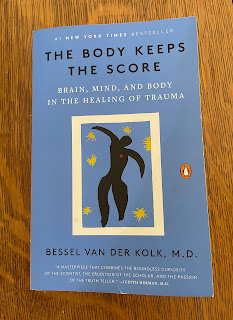
Bessel van der Kolk is one of the world’s leading experts in trauma and its treatment. In his classic book The Body Keeps the Score: Brain, Mind, and Body in the Healing of Trauma, Dr. van der Kolk describes how both sides in World War I mistreated their traumatized soldiers. Depending on the whims of individual doctors, British servicemen originally would either get a diagnosis of “shell shock,” which entitled them to treatment and a disability pension, or “neurasthenia,” which got them nothing. Then in June 1917, the British General Staff issued an order stating “In no circumstances whatever will the expression ‘shell shock’ be used verbally or recorded in any regimental or other casualty report, or any hospital or other medical document.” According to Dr. van der Kolk, “The Germans were even more punitive and treated shell shock as a character defect, which they managed with a variety of painful treatments, including electroshock.” 


During World War II, my grandfather’s generation benefited from more humane leadership and more effective psychiatric treatments. They also had the benefit of fighting and winning a “good war,” followed by the GI Bill and fifty years of peace and prosperity. Meanwhile, individuals and society mostly repressed the lingering impact of wartime trauma. 


In contrast, Vietnam was a “bad” war in every way, which likely amplified its traumatic impact on American veterans. When Dr. van der Kolk began his medical career with the Veterans Administration during the 1970s, he was struck by the fact that all his psychiatric patients were “young, recently discharged Vietnam veterans,” even though the VA hospital was filled with aging WWII vets who were all being treated for purely “medical” complaints:  “My sense was that neither the doctors nor their patients wanted to revisit the war.”


In a sign of the times, the term “Post-Traumatic Stress Disorder” was coined in 1978. The diagnosis was added to the DSM-III in 1980, with criteria that continue to reflect its status as an event-based disorder.


Dr. van der Kolk is the founder of the Trauma Research Foundation and the National Child Traumatic Stress Network. Although his work began with Vietnam veterans, he quickly recognized trauma also affects other vulnerable populations. In particular, “child abuse and neglect is the single most preventable cause of mental illness, the single most common cause of drug and alcohol abuse, and a significant contributor to leading causes of death such as diabetes, heart disease, cancer, stroke, and suicide.”

As the Department of Veteran’s Affairs recognizes, “Many traumatic events (e.g., car accidents, natural disasters, etc.) are of time-limited duration. However, in some cases people experience chronic trauma that continues or repeats for months or years at a time.” In 1988, Dr. Judith Herman proposed a new diagnosis of “complex PTSD.” In addition to the symptoms associated with classic PTSD, complex PTSD includes: 

  • Behavioral difficulties (e.g. impulsivity, aggressiveness, sexual acting out, alcohol/drug misuse and self-destructive behavior) 
  • Emotional difficulties (e.g. affect lability, rage, depression and panic) 
  • Cognitive difficulties (e.g. dissociation and pathological changes in personal identity) 
  • Interpersonal difficulties (e.g. chaotic personal relationships) 
  • Somatization (resulting in many visits to medical practitioners) 

Rather than a single traumatic event, complex PTSD is a consequence of ongoing trauma that occurs over an extended period, such as childhood abuse and neglect, domestic violence, and religious trauma. Because these types of experiences tend to involve betrayals by an individual’s most trusted authority figures, the resulting symptoms focus on impaired interpersonal relationships. Although the DSM-5 does not include diagnoses for complex PTSD or codependency, complex PTSD is already recognized by the Department of Veterans’ Affairs, the World Health Organization, and the British National Health Service.


Here is Stephanie Foo's reaction when she ended the Zoom call with her therapist and found the VA webpage after googling complex PTSD”:


It is not so much a medical document as it is a biography of my life: The difficulty regulating my emotions. The tendency to overshare and trust the wrong people. The dismal self-loathing. The trouble I have maintaining relationships. The unhealthy relationship with my abuser. The tendency to be aggressive but unable to tolerate aggression from others. It’s all true. It’s all me. The more I read, the more every aspect of my personhood is reduced to deep diagnostic flaws. I hadn’t understood how far the disease had spread. How complete its takeover of my identity was. The things I want. The things I love. The way I speak. My passions, my fears, my zits, my eating habits, the amount of whiskey I drink, the way I listen, and the things I see. Everything—everything, all of it—is infected. My trauma is literally pumping through my blood, driving every decision in my brain.
 

It is this totality that leaves me frantic with grief. For years I’ve labored to build myself a new life, something very different from how I was raised. But now, all of a sudden, every conflict I’ve encountered, every loss, every failure and foible in my life, can be traced back to its root: me. I am far from normal. I am the common denominator in the tragedies of my life. I am a textbook case of mental illness. Well, this explains it all, I think. Of course I’ve been having trouble concentrating on my work. Of course so many people I've loved have left. Of course I was wrong to think I could walk into fancy institutions full of well-bred, well-educated people and succeed. Because the person with C-PTSD, the person who is painted here on the internet, is broken.         


Stephanie Foo’s bleak epiphany comes near the beginning of her story, which is subtitled “A Memoir of Healing from Complex Trauma.” Eventually she recognized her disability had clouded her vision, and learned that healing is “the opposite of the ambiguous dread: fullness.


I am full of anger, pain, peace, love, of horrible shards and exquisite beauty, and the lifelong challenge will be to balance all of those things, while keeping them in the circle. Healing is never final. It is never perfection. But along with the losses are the triumphs. I accept the lifelong battle and its limitations now. Even though I must always carry the weight of grief on my back, I have become strong.


Foo’s “inner narrative” finally changed “from a hateful whip-bearing tyrant to a chill(er) surfer dude. Like love and bankruptcy, it happened slowly, then all at once.”


In many ways my journey through complex trauma and PTSD parallels Foo’s. Both of us escaped from our abusive origins by joining demanding professions – journalism and law – that turned out to be toxic. Yet we both found healing through writing, with the support of true friends and expert healthcare providers. 


Nevertheless, my experience with complex PTSD differs from Foo’s in important respects. Like so many other trauma victims, Foo’s symptoms are rooted in the pattern of abuse she suffered at the hands of her own family. I am an outlier because I was betrayed by a different kind of trusted authority figure – the Mormon priesthood leaders who told me homosexuality was a spiritual disease that could be “cured,” and who continue to deny the humanity and existence of LGBT individuals today. Fortunately, in contrast with most people who struggle with complex PTSD symptoms, I had and have the support of the best family in the world. But I also had the traumatic overlay of coming out of the closet at the height of the AIDS epidemic, when silence and rage both equaled death.


In contrast with Stephanie Foo, no one ever told me “There's no way someone could come from your background and not have complex PTSD.” Who can predict something like that? As every personal or global disaster demonstrates, individual responses to trauma will vary. What I do know is there’s no way someone could come through all this and not be a trauma survivor. If they weren’t survivors, they wouldn't have made it through – as so many of my tribe can attest. Those of us who remain.


My friend Paul’s anger at his healthcare providers probably contributed to his suicidal distress. Stephanie Foo reacted to her belatedly revealed diagnosis not only with rage, but also with resolve:


After I started realizing the magnitude of what having C-PTSD meant, I was livid at Samantha for not telling me about it sooner. This should not have been a secret, I thought. My diagnosis should have been a critical part of the conversation about my mental health this entire time.


So Foo fired her longtime therapist and began treatment with a New York psychiatrist who is one of the world’s experts in complex PTSD.


Why don’t I complain about my doctor’s original label for my disability seven years ago? Because he got it right. As I’ve reported from the beginning, after hearing about my symptoms and my background, Dr. Heuristic diagnosed me with “PTSD and serious codependency.” In addition to referring me to a therapist who specialized in treating PTSD, he also directed me to read Facing Codependency by Pia Mellody, and to attend weekly meetings sponsored by Codependents Anonymous (“CODA”). Because of my doctor’s experience with the recovery community, he recognized I would benefit from CODA’s group therapy model.


As the term is used by CODA, “codependency” refers to a pattern of deeply rooted compulsive behaviors that interfere with individuals’ ability to sustain healthy relationships, maintain functional boundaries, and express their reality appropriately. These are the same symptoms that distinguish complex PTSD from the “classic” PTSD diagnosis in the DSM. At the beginning of each CODA meeting, everyone recites the words “Many of us were raised in families where addictions existed - some of us were not.” I’m one of the “some of us.” It turns out being gay among the Mormons can be more harmful than growing up in a saloon.


Paul and Roger in Grade 4


Labels are not the patient. 


This year I’ve been reading through all of Oliver Sacks’ books. Dr. Sacks, a distinguished neurologist who died in 2015, was an extraordinary observer of the great diversity in human thinking. Most recently I finished his classic The Man Who Mistook His Wife for a Hat, a fascinating collection of case studies. In the introduction, Dr. Sacks writes that when he was a young medical student 


it was the patients I saw, their predicaments and their stories, that gripped my imagination, and these experiences imprinted themselves upon me indelibly. Lectures and textbooks, abstracted from living experience, left almost no impression. I was, however, strongly drawn to the case histories that abounded in the nineteenth-century medical literature-rich, detailed descriptions of patients with neurological or psychiatric problems. It is only by accumulating case histories of people with similar syndromes, comparing and contrasting them, that one can more fully understand the mechanisms involved and their resonances for an individual life….  With the rise of neuroscience and all its wonders, it is even more important now to preserve the personal narrative, to see every patient as a unique being with his own history and strategies for adapting and surviving. 


Since moving to Bellingham, my family has been blessed with exceptional caregivers. In particular, my physician has guided my recovery with insight and compassion. He immediately figured out my weird symptoms added up to Post-Traumatic Stress Disorder and codependency. He correctly diagnosed my tennis elbow and plantar fasciitis. He’s much nicer than Dr. House, the abrasive but insightful head of TV’s fictional “Department of Diagnostic Medicine.” He doesn’t laugh at my jokes about suing people for malpractice, but doctors never do. 


I originally gave my doctor his nickname because a “heuristic” is a simple procedure that our brains use to find quick answers to difficult questions. An expert’s various heuristics add up to an effective algorithm. Eventually I figured out my doctor’s heuristic for me. Whenever I show up with some new complaint, he will generally select from a repertoire of three standard responses:

  1. It's just another typical PTSD symptom.
  2. It’s a common side effect of my medications.
  3. It’s what happens when we get older. (He calls these “barnacles.”)

Nevertheless, Dr. Heuristic isn’t trapped by diagnostic categories. He sees each patient as an individual. He’s the opposite of the lawyers that surround me, who are blinded by confirmation bias, and so in love with the sound of their own voices that they cannot hear my scratchy lament. Because my doctor pays attention, he can help his patients find the answers they need. Rather than “Dr. Heuristic,” perhaps a better label for my insightful physician would be “Dr. Epiphany.”


Tuesday, March 8, 2022

The Best Things That Ever Happened To Me

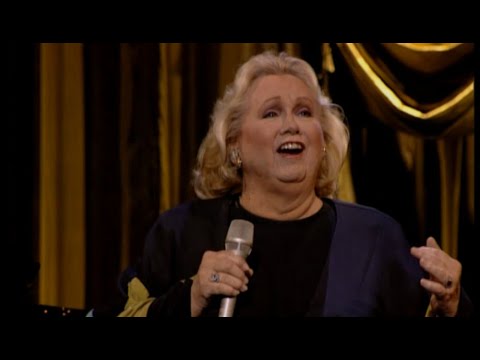
Barbara Cook singing "Anyone Can Whistle" on YouTube

Every musical theatre nerd mourns the loss of Stephen Sondheim, our adoptive artistic father, who died in November 2021 at age 91. I heard the incomparable composer speak a few years ago when I was still a lawyer in Seattle. Frank Rich interviewed Sondheim on the stage at Benaroya Hall in an event presented by Seattle Arts & Lectures. 


The year my mother turned sixty, I bought us tickets to see Barbara Cook perform at Benaroya. She was touring with a concert consisting of music by Sondheim, plus a few other showtunes he told Barbara he “wished he had written.” For her encore, Barbara sang an unadorned arrangement of “Anyone Can Whistle,” accompanied at the piano by her longtime musical director Wally Harper.


Anyone who gets to share Barbara Cook singing “Mostly Sondheim” with his mother is a pretty lucky fella.


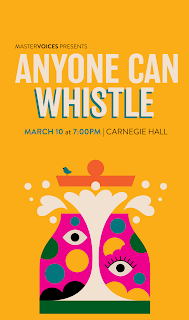
This week’s “Must See” list in New York magazine highlights Thursday’s extraordinary musical event:


In a big Carnegie Hall celebration, MasterVoices honors one of Stephen Sondheim’s earlier, odder cult favorites, a 1964 satire written with Arthur Laurents about fake miracles, asylum patients who take over a town, and a corrupt (or playful?) solution for public health. Revivals of Whistle don’t come along often, but concert productions have kept its weird flame flickering. Vanessa Williams plays Cora, the crooked mayor. 


A young Angela Lansbury was destined for musical theatre immortality after originating the role of the mayoress, even though the original production closed after just nine performances. I’ve never seen Anyone Can Whistle. No one has. But in addition to tackling mental illness, the show introduced Sondheim standards like “There Won’t Be Trumpets,” “I’ve Got You to Lean On,” and “Everybody Says Don’t.”


Obviously I know the original cast album by heart, as well as the recording of the famous AIDS benefit at Carnegie Hall in 1995. Madeleine Kahn played the mayor, Angela Lansbury narrated, and Scott Bakula was mysterious stranger J. Bowden Hapgood. Bernadette Peters played Nurse Fay, who sings the title song.


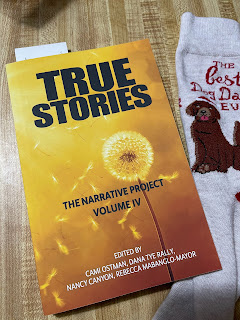
Read “For Good,” my story about the dogs, 

in the recently published anthology True Stories Vol. IV


I’m almost to the end of my first book manuscript, entitled Anyone Can Whistle: A Memoir of Religion, Showtunes, and Mental Illness. I’ll finish writing the memoir as soon as I finish living through this part of my story – hopefully later this year.


A couple of years ago, I went through The Narrative Project’s flagship “Finish Your Book!” writing program. Under Cami Ostman’s expert guidance, I found a writer’s community where I learned to write through and about trauma. The nine-month program offered the perfect opportunity to practice my craft with the support and encouragement of other writers – even as I endured gaslighting lawyers and stonewalling bureaucrats, and single parented three teenagers through a pandemic.


I thought I would finish writing my memoir during the formal The Narrative Project program. Instead, I made immeasurable progress toward mental health and happiness. Meanwhile, after over half a million words of public blog essays and an even greater volume of legal filings and private journaling, Anyone Can Whistle needed to find its own voice and structure as a book. And to lose weight.


So I ruthlessly edited out all the tedious lawyer stuff, exiling it to a future sequel. The title will be Too Many Lawyers, an homage to my favourite mystery novelist Rex Stout, who published “Too Many Witnesses,” “Too Many Cooks,” “Too Many Clients,” and “Too Many Women.” Everything Is Connected became the working title for my research and writing about neuroscience and psychology. It would be my dissertation, if they awarded graduate degrees for reading a lot of interesting books while recovering your mental health. 


As I sit at my desk each morning, I ask myself whether today’s best story will be about a Father, a Writer, or a Lawyer. Readers vote overwhelmingly for “Father.” So as soon as I’m done with my tedious lawsuits and can finish telling my gay Mormon PTSD story in Anyone Can Whistle, I’ll focus on writing about Gay Sitcom Dad.


As I wrote in “Buster,” last month I was one of the writers reading from our recent work at the launch of a new anthology. My contribution to True StoriesFor Good,” comes from the chapter of my memoir where I explain that Im not really a dog person.


Bear and Buster are purebred Aussiedoodles – one of the most popular of the trendy class of “doodles.” My ex and his husband were friends with a local breeder. I never wanted a dog myself – to the contrary, I was comfortable in my role as the dogs’ fabulous gay uncle. Besides, if I’d chosen a dog, I would have picked what in my day we called a “mutt.”


When my ex and his husband divorced a couple of years later and I ended up with three kids and two dogs fulltime, Bear turned out to be the comfort animal I never knew I needed. Although many of the dogs Bear and I encounter on our walks look like mutts, their owners always refer to them as “rescue dogs.” I feel like a “rescue human.” A rescued human.


Each of the chapter titles in my memoir is the name of a showtune, such as “If You Were Gay,” “Turn It Off,” and “I’d Rather be Sailing.” The title for my dog chapter is from Wicked. I’ve seen Wicked three times: (1) the original production on Broadway with Kristin Chenoweth and Idina Menzel; (2) with my mother for her 70th birthday at a lavish benefit for marriage equality at the Paramount Theater in Seattle; and (3) at the Queen Elizabeth Theatre in Vancouver with my daughter Eleanor for her ninth birthday. It’s hard to pick a favourite performance.


For Good” comes near the end of Wicked. Elphaba and Glinda sing “I don’t know if I’ve been changed for better, but because I knew you, I have been changed for good.”


Stephen Sondheim won his Pulitzer Prize for Sunday in the Park with George, which is a musical about Children and Art. In addition to his artistic genius, Sondheim was a born teacher who often said his greatest regret was never having children. 


I came to fatherhood unexpectedly and late in life. The President of the Mormon Church when I was born was David O. McKay. President McKay’s famous motto was “No amount of success can compensate for failure in the home.” Growing up as a closeted gay Mormon during that era, I was taught that fatherhood was essential to human happiness – yet impossible for me. 


It Gets Better. I was forty-one years old when I watched my daughter Eleanor being born. We adopted Rosalind three and a half years later, and Oliver the following year. Having children transformed my life.


Every science fiction fan knows there are fixed points that connect the multiverse. The most important moment on my own timeline occurred in Spring 2011, when we salvaged Oliver’s adoption. Since 2011, I have made numerous mistakes I would reverse if I could. I have been beset by plagues I would have avoided with the benefit of Doctor Who’s or the Flash’s time traveling abilities. I would love a do-over of the last few years. 


I also made a lot of mistakes before 2011. I suffered trauma that still haunts me. But I would not change a single moment that led me to my daughter, child, and son.


The first Sondheim show I saw on Broadway was Into the Woods with Bernadette Peters. I also saw his next two Broadway openings, Assassins with Neil Patrick Harris and Passion with Donna Murphy. Sondheim and others describe Passion as his most personal work, because he wrote it after falling in love for the first time in his life.


If I had a favourite song it would be “If Love Were All,” from a forgotten 1928 musical by Noel Coward. Bitter Sweet is about an English maiden who must choose between her stuffy nobleman fiancé and her dashing Austrian music tutor. (Spoiler alert: she runs off with the musician.) The song is actually sung by the musicians plucky ex-girlfriend – sorta like Eponine pining after Marius in Les Miserables


In her classic cabaret album It’s Better with a Band, Barbara Cook sings a lovely version of “If Love Were All.” But the definitive performance is from Judy Garland’s legendary Carnegie Hall concert on April 23, 1963. You can listen to Judy for yourself on YouTube.


If wealth were all, I would be a failure.


If professional success were all, I would be bitter.


If art were all, I would be grateful for my own talent to amuse, and the mental health to finally use it.


If social justice were all, I would be proud of what I’ve accomplished so far.


If romantic love were all, I would be as lonely as Judy Garland sounds on her Carnegie Hall concert album.


But if love is all, then I consider myself to be the luckiest man on the face of this earth.


The chapter of my memoir where I write about gay choruses in general and Vancouver Men’s Chorus in particular is called “The Best Thing that Ever Happened to Me.” Windy City Gay Chorus, Seattle Men’s Chorus, and Vancouver Men’s Chorus represent my tribe at its best. 


“The Best Thing that Ever Happened to Me” is the title of a song from Sondheim’s final Broadway musical. Road Show tells the story of colourful brothers Addison Mizner and Wilson Mizner from the Klondike gold rush through the Florida real estate scams of the 1920s. Addison Mizner and Stephen Sondheim both were gay. Sondheim came from a generation that survived homophobic psychoanalysis, yet continued to take comfort from the closet for decades. The composer worked on this particular show for years as it evolved from Gold! to Wise Guys to Bounce before finally opening as Road Show in 2008. “The Best Thing that Ever Happened to Me” started out being sung by Wilson Mizner and his wife Nellie in Bounce, but ended up as a comic love duet in Road Show between Addison Mizner and his lover Hollis Bessemer. 


After the Omicron covid variant temporarily shut down choirs once again, Vancouver Men’s Chorus gathered online for Zoom rehearsals and weekly fellowship. In January we watched the video of our 2018 concert “Gays of Our Lives,” which showcased songs from our communal history of activism and anger, pride marches and prejudice, loss and love. Sondheim was represented by “The Best Thing that Ever Happened to Me.”


You can find a recording of the song on YouTube by the actors who played Addison and Hollis in Road Show on Broadway. But my favourite version of “The Best Thing that Ever Happened to Me” will always be the duet between tenor David Browning and baritone Alex Burns, backed up by the rest of Vancouver Men’s Chorus.


I spent last Wednesday evening with my two favourite Ukrainian-Canadians: my sister-in-law Kyla Moojalwsky Leishman and VMC founder/conductor Willi Zwozdesky. 


I saw Kyla while visiting my brother Doug on the spine floor at Vancouver General Hospital. Then I went to VMC rehearsal, where Willi conducted the entire chorus together in one room and off Zoom for the first time in two years.


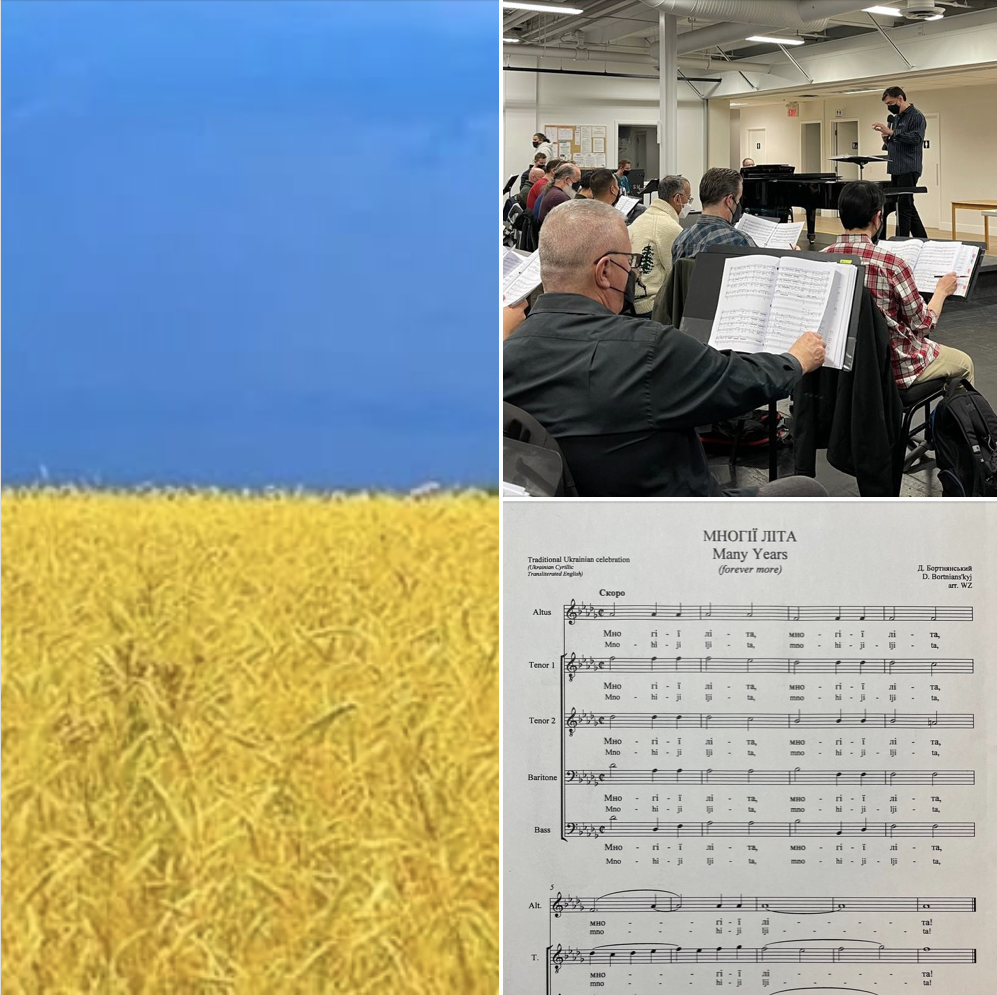
Willi grew up singing Ukrainian folk songs among immigrants on the Prairies before founding Canada’s first LGBT choir in 1981. At rehearsal on Wednesday, Willi handed out the sheet music for “Mnohiji Ljita,” which means “Many Years” in Ukrainian. It’s the celebration song Ukrainians sing at birthdays. Willi picked “Mnohiji Ljita” because we only had to learn two words repeated over and over. You sing the song twice at normal speed, then a third time very slowly and dramatically.


Like every other Ukrainian folk song, “Mnohiji Ljita” usually sounds either like Rachmaninov’s Vespers sung by the Yale Slavic Chorus as a soundtrack to the classic Soviet-era silent movie Battleship Potemkin, or like a vodka-infused group of soldiers linking arms in a Kyiv pub. Sung in four-part harmony by 100 voices from a chorus that survived one plague as a band of brothers only to be silenced temporarily by a new pandemic, “Mnohiji Ljita” sounds like Hope.


In addition to our first real VMC rehearsal in two years, the recent liberalization of BC’s covid restrictions also meant that after rehearsal a group of us were able to gather for drinks at our longstanding watering hole PumpJack. (Sadly, showtune singalong night remains homeless and on indefinite hiatus.)


While at PumpJack I chatted with Xavi, a fellow Second Tenor who also happens to be a regular reader of my blog. When I asked him which kinds of anecdotes he prefers, Xavi voted for Gay Sitcom Dad. So over a couple of ginger-infused cidres I regaled him with unprintable stories from my less than fabulous life. Before heading for the border, I thanked Xavi and told him I couldn’t remember the last time I had the opportunity to talk to someone who wasn’t named “Leishman” or “Bear.” (Xavi realizes Bear is the name of my dog, not my porn fantasy.)


At rehearsal last week we got copies of the new songs for our June concert that VMC’s stable of arrangers completed during the pandemic. “Chosen Family” is by Rina Sawayama, a Japanese woman who lives in Britain. (Here’s a YouTube link to her singing it as a duet with Elton John.) The lyrics include “We don’t need to be related to relate, we don’t need to share genes or a surname – you are my chosen family.” The best things that ever happened to me are my biological, adoptive, and chosen families.