Showing posts with label Codependency. Show all posts

Thursday, September 1, 2022

Relabeling


I met my best friend Paul in 1970 on the first day of Grade 1. Like my best friends in high school, college, and law school, Paul turned out to be gay. (Apparently I’m contagious.) 


Paul also turned out to be mentally ill. After struggling with depression, anxiety, and other challenges, Paul killed himself twenty years ago.


I thought of my friend Paul while reading the first chapter of Stephanie Foo’s recent memoir. A few months before he died, Paul told me he felt betrayed by his healthcare providers. While peeking at his medical charts, he discovered he had Borderline Personality Disorder, a bleak diagnosis that was even bleaker two decades ago. No one bothered to tell Paul, which made it even worse.


In What My Bones Know: A Memoir of Healing from Complex Trauma, Foo writes about growing up in San Jose with dysfunctional immigrant parents who subjected her to relentless physical and emotional abuse before abandoning her as a teenager. Foo escaped to college, found an effective therapist, and went on to a successful career in Bay Area public radio. Eventually Foo moved to New York to work as a producer at This American Life, the granddaddy of podcasts. 


Nevertheless, Foo found herself increasingly frustrated with challenges at work and in her relationships. At age thirty she was still seeing the same therapist, now via Zoom. Eventually she asked “Do you think I’m bipolar?”


Samantha actually laughs. “You are not bipolar. I am sure of it.” she says. And that’s when she asks, “Do you want to know your diagnosis?”

I don’t yell, “Lady, I've been seeing you for a fucking decade, yes I want to know my goddamn diagnosis,” because Samantha taught me about appropriate communication. Thanks, Samantha. Instead, I say, “Yes. Of course.”

Something in her jaw becomes determined, and her gaze is direct. “You have complex PTSD from your childhood, and it manifests as persistent depression and anxiety. There’s no way someone with your background couldn’t have it,” she says.

“Oh. Yeah, PTSD.” Post-traumatic stress disorder. I had a crappy childhood, so I kinda figured that.

“Not just PTSD. Complex PTSD. The difference between regular PTSD and complex PTSD is that traditional PTSD is often associated with a moment of trauma. Sufferers of complex PTSD have undergone continual abuse-trauma that has occurred over a long period of time, over the course of years. Child abuse is a common cause of complex PTSD,” she says. Then her eyes drift to the corner of the screen. “Oh—we're out of time! Let’s continue this next week.”


We’ve recognized for millennia that wartime trauma causes a predictable constellation of physical and mental symptoms. In the 4000-year old Epic of Gilgamesh, the warrior-hero experiences intrusive memories and nightmares after witnessing the death of his best friend. Greek historian Herodotus described an Athenian soldier who was stricken with blindness in 490 B.C. when he observed the death of a comrade at the battle of Marathon. After the Civil War, veterans developed “soldier’s heart.” The term “shell shock” first appeared in The Lancet in February 1915, six months after World War I began. 


Seven years ago I moved to Bellingham to accept a position with the Washington Attorney General’s Office as general counsel to Western Washington University. My dream job became a nightmare when I began exhibiting strange new symptoms, including bizarre anxiety tics and skewed personal interactions. I was shocked when my new Bellingham physician, Dr. Heuristic, diagnosed me with PTSD and serious codependency. 


As I told a friend who developed PTSD after serving as an Army Ranger medic in Afghanistan, I was sheepish about sharing the same DSM-5 category with someone like him. He told me not to be concerned, and that soldiers feel lucky they get so many folks’ respect. They worry instead about the many women and children who are scarred by the impact of earlier domestic abuse and do not have access to the help they need.


Or as Stephanie Foo writes:


It is a great, sexist irony that in our society, PTSD is generally considered a male condition. It is the warrior's disease, a blight of the mind that must be earned by time in battle, in some dangerous overseas desert or jungle. But the real statistics suggest the opposite: Women are more than twice as likely to have PTSD than men. Ten percent of women are expected to suffer from PTSD in their lifetimes, as opposed to just 4 percent of men. But even after #Me Too, a global movement to recognize the legitimacy of women's trauma, treatment for this trauma remains a half-assed endeavor, an afterthought in the shadow of the glory of war. And it has always been this way.


Actually, it usually has been even worse. 


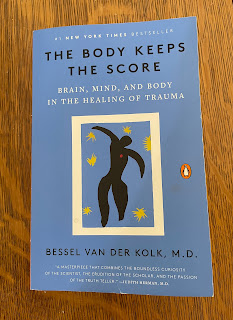
Bessel van der Kolk is one of the world’s leading experts in trauma and its treatment. In his classic book The Body Keeps the Score: Brain, Mind, and Body in the Healing of Trauma, Dr. van der Kolk describes how both sides in World War I mistreated their traumatized soldiers. Depending on the whims of individual doctors, British servicemen originally would either get a diagnosis of “shell shock,” which entitled them to treatment and a disability pension, or “neurasthenia,” which got them nothing. Then in June 1917, the British General Staff issued an order stating “In no circumstances whatever will the expression ‘shell shock’ be used verbally or recorded in any regimental or other casualty report, or any hospital or other medical document.” According to Dr. van der Kolk, “The Germans were even more punitive and treated shell shock as a character defect, which they managed with a variety of painful treatments, including electroshock.” 


During World War II, my grandfather’s generation benefited from more humane leadership and more effective psychiatric treatments. They also had the benefit of fighting and winning a “good war,” followed by the GI Bill and fifty years of peace and prosperity. Meanwhile, individuals and society mostly repressed the lingering impact of wartime trauma. 


In contrast, Vietnam was a “bad” war in every way, which likely amplified its traumatic impact on American veterans. When Dr. van der Kolk began his medical career with the Veterans Administration during the 1970s, he was struck by the fact that all his psychiatric patients were “young, recently discharged Vietnam veterans,” even though the VA hospital was filled with aging WWII vets who were all being treated for purely “medical” complaints:  “My sense was that neither the doctors nor their patients wanted to revisit the war.”


In a sign of the times, the term “Post-Traumatic Stress Disorder” was coined in 1978. The diagnosis was added to the DSM-III in 1980, with criteria that continue to reflect its status as an event-based disorder.


Dr. van der Kolk is the founder of the Trauma Research Foundation and the National Child Traumatic Stress Network. Although his work began with Vietnam veterans, he quickly recognized trauma also affects other vulnerable populations. In particular, “child abuse and neglect is the single most preventable cause of mental illness, the single most common cause of drug and alcohol abuse, and a significant contributor to leading causes of death such as diabetes, heart disease, cancer, stroke, and suicide.”

As the Department of Veteran’s Affairs recognizes, “Many traumatic events (e.g., car accidents, natural disasters, etc.) are of time-limited duration. However, in some cases people experience chronic trauma that continues or repeats for months or years at a time.” In 1988, Dr. Judith Herman proposed a new diagnosis of “complex PTSD.” In addition to the symptoms associated with classic PTSD, complex PTSD includes: 

  • Behavioral difficulties (e.g. impulsivity, aggressiveness, sexual acting out, alcohol/drug misuse and self-destructive behavior) 
  • Emotional difficulties (e.g. affect lability, rage, depression and panic) 
  • Cognitive difficulties (e.g. dissociation and pathological changes in personal identity) 
  • Interpersonal difficulties (e.g. chaotic personal relationships) 
  • Somatization (resulting in many visits to medical practitioners) 

Rather than a single traumatic event, complex PTSD is a consequence of ongoing trauma that occurs over an extended period, such as childhood abuse and neglect, domestic violence, and religious trauma. Because these types of experiences tend to involve betrayals by an individual’s most trusted authority figures, the resulting symptoms focus on impaired interpersonal relationships. Although the DSM-5 does not include diagnoses for complex PTSD or codependency, complex PTSD is already recognized by the Department of Veterans’ Affairs, the World Health Organization, and the British National Health Service.


Here is Stephanie Foo's reaction when she ended the Zoom call with her therapist and found the VA webpage after googling “complex PTSD”:


It is not so much a medical document as it is a biography of my life: The difficulty regulating my emotions. The tendency to overshare and trust the wrong people. The dismal self-loathing. The trouble I have maintaining relationships. The unhealthy relationship with my abuser. The tendency to be aggressive but unable to tolerate aggression from others. It’s all true. It’s all me. The more I read, the more every aspect of my personhood is reduced to deep diagnostic flaws. I hadn’t understood how far the disease had spread. How complete its takeover of my identity was. The things I want. The things I love. The way I speak. My passions, my fears, my zits, my eating habits, the amount of whiskey I drink, the way I listen, and the things I see. Everything—everything, all of it—is infected. My trauma is literally pumping through my blood, driving every decision in my brain.


It is this totality that leaves me frantic with grief. For years I’ve labored to build myself a new life, something very different from how I was raised. But now, all of a sudden, every conflict I’ve encountered, every loss, every failure and foible in my life, can be traced back to its root: me. I am far from normal. I am the common denominator in the tragedies of my life. I am a textbook case of mental illness. Well, this explains it all, I think. Of course I’ve been having trouble concentrating on my work. Of course so many people I've loved have left. Of course I was wrong to think I could walk into fancy institutions full of well-bred, well-educated people and succeed. Because the person with C-PTSD, the person who is painted here on the internet, is broken.         
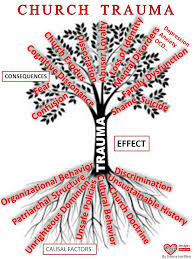


Stephanie Foo’s bleak epiphany comes near the beginning of her story, which is subtitled “A Memoir of Healing from Complex Trauma.” Eventually she recognized her disability had clouded her vision, and learned that healing is “the opposite of the ambiguous dread: fullness.”


I am full of anger, pain, peace, love, of horrible shards and exquisite beauty, and the lifelong challenge will be to balance all of those things, while keeping them in the circle. Healing is never final. It is never perfection. But along with the losses are the triumphs. I accept the lifelong battle and its limitations now. Even though I must always carry the weight of grief on my back, I have become strong.


Foo’s “inner narrative” finally changed “from a hateful whip-bearing tyrant to a chill(er) surfer dude. Like love and bankruptcy, it happened slowly, then all at once.”


In many ways my journey through complex trauma and PTSD parallels Foo’s. Both of us escaped from our abusive origins by joining demanding professions – journalism and law – that turned out to be toxic. Yet we both found healing through writing, with the support of true friends and expert healthcare providers. 


Nevertheless, my experience with complex PTSD differs from Foo’s in important respects. Like so many other trauma victims, Foo’s symptoms are rooted in the pattern of abuse she suffered at the hands of her own family. I am an outlier because I was betrayed by a different kind of trusted authority figure – the Mormon priesthood leaders who told me homosexuality was a spiritual disease that could be “cured,” and who continue to deny the humanity and existence of LGBT individuals today. Fortunately, in contrast with most people who struggle with complex PTSD symptoms, I had and have the support of the best family in the world. But I also had the traumatic overlay of coming out of the closet at the height of the AIDS epidemic, when silence and rage both equaled death.


In contrast with Stephanie Foo, no one ever told me “There's no way someone could come from your background and not have complex PTSD.” Who can predict something like that? As every personal or global disaster demonstrates, individual responses to trauma will vary. What I do know is there’s no way someone could come through all this and not be a trauma survivor. If they weren’t survivors, they wouldn't have made it through – as so many of my tribe can attest. Those of us who remain.


My friend Paul’s anger at his healthcare providers probably contributed to his suicidal distress. Stephanie Foo reacted to her belatedly revealed diagnosis not only with rage, but also with resolve:


After I started realizing the magnitude of what having C-PTSD meant, I was livid at Samantha for not telling me about it sooner. This should not have been a secret, I thought. My diagnosis should have been a critical part of the conversation about my mental health this entire time.


So Foo fired her longtime therapist and began treatment with a New York psychiatrist who is one of the world’s experts in complex PTSD.


Why don’t I complain about my doctor’s original label for my disability seven years ago? Because he got it right. As I’ve reported from the beginning, after hearing about my symptoms and my background, Dr. Heuristic diagnosed me with “PTSD and serious codependency.” In addition to referring me to a therapist who specialized in treating PTSD, he also directed me to read Facing Codependency by Pia Mellody, and to attend weekly meetings sponsored by Codependents Anonymous (“CODA”). Because of my doctor’s experience with the recovery community, he recognized I would benefit from CODA’s group therapy model.


As the term is used by CODA, “codependency” refers to a pattern of deeply rooted compulsive behaviors that interfere with individuals’ ability to sustain healthy relationships, maintain functional boundaries, and express their reality appropriately. These are the same symptoms that distinguish complex PTSD from the “classic” PTSD diagnosis in the DSM. At the beginning of each CODA meeting, everyone recites the words “Many of us were raised in families where addictions existed - some of us were not.” I’m one of the “some of us.” It turns out being gay among the Mormons can be more harmful than growing up in a saloon.


Paul and Roger in Grade 4


Labels are not the patient. 


This year I’ve been reading through all of Oliver Sacks’ books. Dr. Sacks, a distinguished neurologist who died in 2015, was an extraordinary observer of the great diversity in human thinking. Most recently I finished his classic The Man Who Mistook His Wife for a Hat, a fascinating collection of case studies. In the introduction, Dr. Sacks writes that when he was a young medical student 


it was the patients I saw, their predicaments and their stories, that gripped my imagination, and these experiences imprinted themselves upon me indelibly. Lectures and textbooks, abstracted from living experience, left almost no impression. I was, however, strongly drawn to the case histories that abounded in the nineteenth-century medical literature-rich, detailed descriptions of patients with neurological or psychiatric problems. It is only by accumulating case histories of people with similar syndromes, comparing and contrasting them, that one can more fully understand the mechanisms involved and their resonances for an individual life….  With the rise of neuroscience and all its wonders, it is even more important now to preserve the personal narrative, to see every patient as a unique being with his own history and strategies for adapting and surviving. 


Since moving to Bellingham, my family has been blessed with exceptional caregivers. In particular, my physician has guided my recovery with insight and compassion. He immediately figured out my weird symptoms added up to Post-Traumatic Stress Disorder and codependency. He correctly diagnosed my tennis elbow and plantar fasciitis. He’s much nicer than Dr. House, the abrasive but insightful head of TV’s fictional “Department of Diagnostic Medicine.” He doesn’t laugh at my jokes about suing people for malpractice, but doctors never do. 


I originally gave my doctor his nickname because a “heuristic” is a simple procedure that our brains use to find quick answers to difficult questions. An expert’s various heuristics add up to an effective algorithm. Eventually I figured out my doctor’s heuristic for me. Whenever I show up with some new complaint, he will generally select from a repertoire of three standard responses:

  1. It's just another typical PTSD symptom.
  2. It’s a common side effect of my medications.
  3. It’s what happens when we get older. (He calls these “barnacles.”)

Nevertheless, Dr. Heuristic isn’t trapped by diagnostic categories. He sees each patient as an individual. He’s the opposite of the lawyers that surround me, who are blinded by confirmation bias, and so in love with the sound of their own voices that they cannot hear my scratchy lament. Because my doctor pays attention, he can help his patients find the answers they need. Rather than “Dr. Heuristic,” perhaps a better label for my insightful physician would be “Dr. Epiphany.”




Thursday, February 3, 2022

Buster


Yesterday was the ancient feast of Candlemas, also known as Groundhog Day, when we celebrate the greatest work of comic moral philosophy in the Western Canon. 


Obviously I’m referring to the 1993 rom-com Groundhog Day, starring national treasure Bill Murray. If you need it, here is IMDB’s summary of the classic film:


A self-centered Pittsburgh weatherman finds himself inexplicably trapped in a small town as he lives the same day over and over again.


The McGuffin driving the plot is the fact that the “small town” is Punxsutawney, Pennsylvania, and the “same day” is February 2. Once a year, beloved rodent Punxsutawney Phil wakes up and confronts his demons. Murray plays grumpy weatherman Phil Connors, in town to cover the annual ritual.


Groundhog Day tells the redemption story of Phil Connors’ transformation from miserable misanthrope to pillar of the community, all in one very long and repetitive day. 


The first time through Phil’s day, the movie provides a framework for the rest of the story by introducing his news team, various Punxsatawney residents, and their key encounters. The town’s high holy day culminates in a big party. As the same day repeats a few times in the next section of the movie, Phil figures out the nature of his existential trap, and goofs off with predictable self-indulgence. Then we see do-over montages as Phil learns through trial and error how to succeed at various tasks, such as fixing tires, saving lives, and barging into the home of the town’s piano teacher each day for a “first” piano lesson. 


Gifted essayist and character actor Stephen Tobolowsky, who played insurance agent Ned Ryerson, describes the movie shoot as one of the most magical experiences of his life. Some people think Groundhog Day centers on the growing attraction between Phil and his producer Rita, played by Andie MacDowell. Near the end of the movie, Phil demonstrates one of the many skills you can acquire if you have all the time in the world – by carving an exquisite ice sculpture of his beloved with a chainsaw. Phil finally breaks the curse when he wakes up to find it’s February 3rd and he’s part of a couple.  


For me the heart of Groundhog Day is not the romance, or even the comic montages as Phil gradually perfects his schtick. It’s the party that evening where Phil jams on piano with the band in front of the whole town. Rita learns from witness after witness that Phil spent his day reaching out with love and kindness.


It’s been six years since my world turned upside down after abusive workplace dynamics triggered Post-Traumatic Stress Disorder. With the help of my healthcare providers and the support of the best family in the world, I’ve made immense progress with many of my debilitating symptoms. 


Nevertheless, I will never be “cured.” The stress and tics don’t go away. To the contrary, my trichotillomania and my stammer are worse than ever. Meanwhile, my mind has compensated for the vicious cycle of triggers and traumas by compressing four years of memories into two, as if the guys remodeling my brain poured the foundation off-kilter and the rest of us will have to compensate forever. (Silver lining:  for me the entire Trump presidency seems like just a couple of years.) 


Fortunately, more recently I’ve returned to the light. I’ve regained a hopeful mindset for the first time since childhood. And as I recently wrote in “Snap,” I’ve finally figured out how to slow down enough to think clearly. It involves a lot of long walks with Bear – which had the unfortunate side effect of crippling my right foot with plantar fasciitis. Now I just need to find a podiatrist who takes our terrible health insurance.


Over the last three years I found my personal Groundhog’s Day loop on my daily walks with Bear.


Many of my remaining challenges are social. Trauma had the effect of moving me several notches further away from “normal” on the autism spectrum – particularly during PTSD episodes, while under stress, and/or in my interactions with gay men. I’ve lost much of my already dubious ability to read ordinary social cues. Faces are a blank. Nowadays I can’t tell if someone is hitting on me or challenging me to a duel. Strangers overwhelm me. 


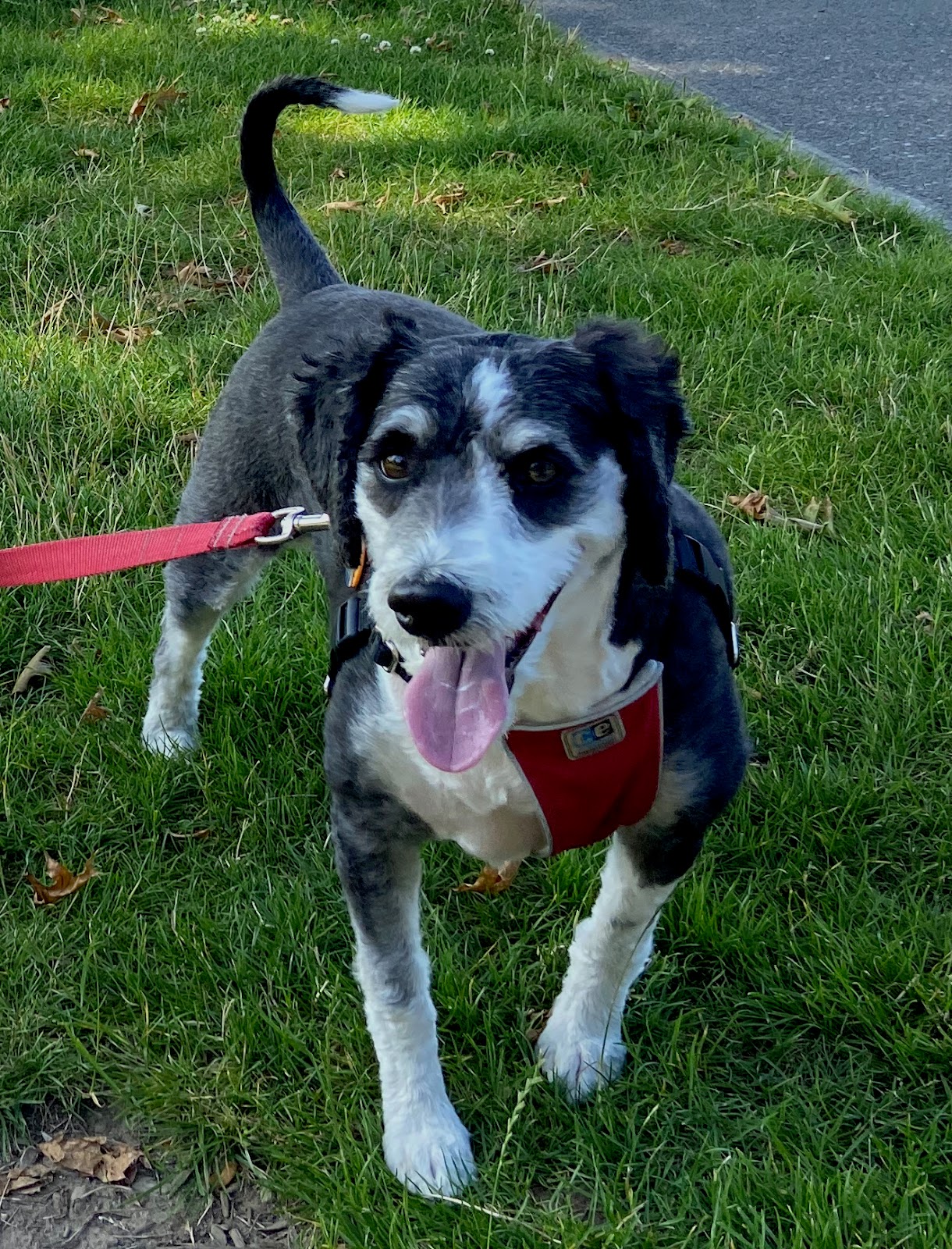
But as I walk along the waterfront trail with Bear, I have the opportunity to repeat the same social interactions over and over. I gracefully thank people who admire his pied beauty. I explain Aussiedoodles are a cross between Australian shepherds and poodles. I talk about the weather, and laugh politely when old men quip “Who’s walking who?” as if I’ve never heard the question before. 


In the beginning I couldn’t sustain a multi-sentence exchange, let alone a conversation. My attempts at humor fell flat and made me seem creepy. But dog people are nice, and you can talk to them about safe topics like de-worming medication and scheduling a groomer. Gradually I added new material. 


Last Saturday, Bear and I walked ten miles in the sunshine. I confidently risked social encounters with a high degree of difficulty. I even had the nerve to say something clever to the cute new guy at the coffee shop who is in the process of dethroning his charming co-worker from the position of Coffee Boy Crush. (I’m only allowed to have one Coffee Boy Crush at a time – a prudent rule imposed long ago in Chicago by my friend Charles.)


My one misstep occurred when I tried to strike up a conversation with a poodle owner wearing too many layers of fleece. I thought I was talking to a white-haired lesbian, but it turned out to be a little old man. Years ago I made the same mistake on my way home from the Gay Softball World Series when I stood in line behind diminutive gay comedian Leslie Jordan. 


Read “For Good,” my story about the dogs, 

in the recently published anthology True Stories Vol. IV


Last weekend I was one of the writers reading from our recent work at the launch of True Stories, a new anthology edited by Cami Ostman, founder of The Narrative Project. Here’s a link to the YouTube video (I’m reading from 35:35 to 39:25), and a link to the site where you can purchase copies of our book.


My contribution to True Stories, “For Good, ” comes from the chapter of my upcoming memoir where I explain that I’m not really a dog person. Here’s an excerpt:


Bear is more attractive than anyone I’ve ever dated – way out of my league. As I walk past strangers on the waterfront trail, I often hear audible sighs of “Aw, he’s sooo cute.” Sadly, it’s never about me.


Nevertheless, the best thing about going on long walks with Bear every day is that everyone we encounter is smiling. Yes, I know they’re not smiling at me. But they’re smiling at us—and at everyone else for a little while. Surely that makes the world a slightly better place.


On our last walk along the Boardwalk, Bear asked if I planned on getting a new dog after he’s gone. I said no. I told Bear I would keep taking care of poor Buster if my daughter turned out to be a flake, but when it comes to pets I’ll stick with the fabulous gay uncle role in the future. Still, regardless of what happens in future, I know that having a dog—having Bear in my life—has changed me for good.


Which brings us to Buster, who has been conspicuously absent from his story so far.


This fall my middle brother and his wife became the first empty nesters from our generation. They immediately bought their first dog, an adorable Labradoodle named Scout who now dominates the family Facebook feed. 


I warned my brother he’s in danger of becoming a dog person permanently. Luckily, I acquired two dogs at once. Bear is the perfect companion for my life right now. In contrast, Buster is a constant reminder that lightning won’t strike twice.


Buster has more tics and is even more socially awkward than me. He steals underwear from the laundry basket and bloody tissues from my pocket, then eats them. He’s clumsy and stupid and a little bit racist. He hates going on walks. If Bear and I drag him along the trail with us, Buster just barks and walks into things before pooping out too soon. Buster’s highest and best use is to lounge on the couch and comfort my children. 


One day last summer, Bear and I begrudgingly included Buster in a necessarily short walk. On the Boardwalk we ran into my ex’s next ex Brenden. After they divorced, my ex moved back to the Midwest and I ended up with the kids fulltime. Plus Bear and Buster. 


Brenden still lives in Bellingham, but his work schedule prevented him from taking the dogs. Instead, he has embraced the guncle role with both children and dogs. The continued support of Brenden and his parents has been essential to the kids’ wellbeing during these challenging times. 


When we ran into Brenden on the Boardwalk, Bear pounced with typical enthusiasm. In contrast with his usual public awkwardness, Buster wildly embraced Brendon and smothered him with kisses. When Brenden continued in the other direction, Buster sat on the Boardwalk pining. He wouldn’t let us leave for thirty minutes, and instead stared longingly into the distance. I realized Brenden was the love of Buster’s life – and that traumatic experiences can shatter even a simple psyche.


Several businesses in Fairhaven identify as dog friendly and offer treats at the counter. If any merchant gives Bear a dog treat just once we can never walk past the doors of that establishment again without going inside. It’s uncanny. Trading treats for hugs with Bear has become the highlight of the day for numerous Village Books employees. 


In contrast, dim-witted Buster approaches every gift of a dog treat like it’s his first time – a happy surprise.


Seasons and school calendars remind us life is cyclical. For people like Buster or Dr. Oliver Sacks’ amnesiac patients, each circle is the same. For others, like Phil Connors before the events of Groundhog Day, life is a downward spiral. Each February Phil would schlep to Punxsatawney, complaining bitterly about everything and everyone, and make every turn of the wheel worse than the one before. The opposite of a redemption story is a “contamination story.”


As I’ve slowly recovered my health over the last few years, I’ve also re-learned the power of positive thinking and hopeful living. In the best book I read last year, What are the Chances? Why We Believe in Luck, neuroscientist and statistician Barbara Blatchley writes 


When lucky people are unlucky – when something unwanted or awful happens – they learn from their mistakes, incorporating that experience into their expectations about the future. They are able to use their transformed expectations to change their bad luck into good for the next time.


Groundhog Day demonstrates the power of evolution:  not biologically as a species, but culturally as a community, and personally as individuals. Unlike Buster, we can choose to spiral upward.


Tuesday, November 2, 2021

Stereotypos


According to the Roman poet Juvenal, a good life begins with Orandum est ut sit mens sana in corpore sano:  “Pray for a healthy mind in a healthy body.” Philosophers and scientists have been arguing for millennia about the relative significance of mind and body .


So where does your brain fit into a mind/body dichotomy? 


The Human Brain / Ice Cream Scoop Analogy


The evolutionary history of your brain can be compared to piling scoops of ice cream on a cone. At the bottom is the reptilian vanilla scoop of our brain stem. Even the simplest animal has a similar need for these neurons dedicated to basic life support and motor functions. Natural selection subsequently piled on extra scoops to handle our more sophisticated motor needs as mammals. 


Meanwhile, evolution added scoops of the fruity flavors that create, regulate, and respond to emotions. Perched precariously on top, at least for humans, is a final delicious scoop containing such revolutionary flavors as the prefrontal cortex, Executive Function, and Theory of Mind. But the ice cream scoops all tend to blend together.


Your brain is the greediest organ in your body – comprising only 2 percent of your mass, while consuming 20 percent of your fuel. The brain’s energy-sucking chemical and electrical processes generate what you experience as your mind. Both mind and body are all about connections:  100 billion neurons linked to each other and to the rest of your body in innumerable combinations and recombinations. Your brain is both hardware and software.


Unsurprisingly, our wires can get crossed. Sometimes in very similar ways.


When my physician diagnosed me with Post-Traumatic Stress Disorder almost six years ago, the most obvious indicator among my strange new symptoms was virulent trichotillomania, i.e. compulsive hair-pulling, that primarily targeted my forehead. I’ve made significant progress toward managing the impact of trauma and triggers on my thinking, but my trichotillomania, stammer, humming, and other body tics have only gotten worse. 


In my search for answers, I’ve learned how much mental health involves contested labels. For example, in 1973 the American Psychiatric Association removed homosexuality from its Diagnostic & Statistical Manual’s catalogue of mental illnesses after a contentious campaign. 


A particular symptom may be listed among the criteria defining multiple disorders, may be identified as its own syndrome, or may be normalized as an example of neurodiversity and healthy variation. We find ourselves using multiple labels to describe basically the same behavioral consequence of crossed neural wiring – including terms like trichotillomania, tics, echolalia, coprolalia, stimming, and stereotypies.


The first time I read the word “stereotypy” I thought it was a typo. 


Apparently so did the copy editor at the New York Times. In “The Case Against Zoos,” a guest essay by Emma Marris, the word appears spelled both correctly and incorrectly in the same paragraph:


In many modern zoos, animals are well cared for, healthy and probably, for many species, content. Zookeepers are not mustache-twirling villains. They are kind people, bonded to their charges and immersed in the culture of the zoo, in which they are the good guys.


But many animals clearly show us that they do not enjoy captivity. When confined they rock, pull their hair and engage in other tics. Captive tigers pace back and forth, and in a 2014 study, researchers found that “the time devoted to pacing by a species in captivity is best predicted by the daily distances traveled in nature by the wild specimens.” It is almost as if they feel driven to patrol their territory, to hunt, to move, to walk a certain number of steps, as if they have a Fitbit in their brains.


The researchers divided the odd behaviors of captive animals into two categories: “impulsive/compulsive behaviors,” including coprophagy (eating feces), regurgitation, self-biting and mutilation, exaggerated aggressiveness and infanticide, and “stereotypies,” which are endlessly repeated movements. Elephants bob their heads over and over. Chimps pull out their own hair. Giraffes endlessly flick their tongues. Bears and cats pace. Some studies have shown that as many as 80 percent of zoo carnivores, 64 percent of zoo chimps and 85 percent of zoo elephants have displayed compulsive behaviors or stereotypes.


“Stereotypies: Bad Habits or Vices?”

I encountered the term “stereotypy” last year in Temple Grandin’s book Animals Make Us Human. As a leading expert on animal behavior, Grandin helps pet owners and farmers understand how each species’ brains work, and how humans can create a healthy environment for each type of animal. 


Grandin describes animal species responding to frustration and captivity with similar patterns of abnormal repetitive behaviors. For example, gerbils in the wild dig for shelter; caged gerbils dig compulsively, with no productive purpose. As Grandin observes, both humans and animals resort to “normal stereotypies” in “high-tension moments.” A life of near-constant stress can result in a life of near-constant stereotypy.


Years ago, a physician friend came back from a global health conference and told me Bill Gates definitely is on the autism spectrum. “Did you examine him? Did he come out from the podium?” I asked.


She said no – she just observed Bill as he rocked back and forth during the speeches.


In addition to her experience with animal husbandry, Temple Grandin also is a leading expert on living with Autism Spectrum Disorder. Grandin sees a parallel between animal stereotypies and similar repetitive behaviors in humans who have been diagnosed with various mental disorders, including autism and what used to be called “Asperger’s Syndrome.” (DSM-5 now puts the formerly separate diagnoses of autism and Asperger’s on the same A.S.D. spectrum.) 


I never noticed the word “stimming” before this year, but apparently it’s been in use for a couple of decades, particularly within the autism community. Stimming refers to "self-stimulating behaviors, usually involving repetitive movements or sounds."


This year I’ve been reading my way through all of Oliver Sacks’ books. Dr. Sacks, a gay Jewish British immigrant who died in 2015 at age 82, was a distinguished neurologist and a best-selling author who wrote with elegance and humanity. Dr. Sacks always maintained a busy clinical practice. The real-life neurological case studies he explored in his various books provide another illuminating perspective on how the neural networks connecting our brains to our bodies’ motor functions can get their wires crossed.


Many of Dr. Sacks’ patients suffered from Parkinsonism and related disorders where the mind loses control over the body, including dyskinesia and Tourette’s Syndrome. Doctors treat these diseases with the same types of anti-psychotic medications as they prescribe for serious mental illnesses like schizophrenia. On a cellular level, thinking and acting are a matter of chemistry. 


According to the Oxford Dictionary, “coprolalia” is “the involuntary and repetitive use of obscene language, as a symptom of mental illness or organic brain disease.” (I’m not a lexicographer, but should we really think of “mental illness” as some kind of inorganic brain disease? Mind/body dualism fails us once again.) Coprolalia is seen in some people with Tourette’s Syndrome – but also in nursing home residents whose stroke damage or dementia lesions have targeted particular brain regions, resulting in little old ladies who swear like sailors.


Oliver Sacks offers the hope of integration. In Musicophilia: Tales of Music and the Brain, he writes about professional musicians with Tourette's Syndrome who are able to harness the energy fueling their tics and direct it toward their creativity:


Tourette’s brings out in stark form questions of will and determination: who orders what, who pushes whom around. To what extent are people with Tourette’s controlled by a sovereign “I,” a complex, self-aware, intentional self, or by impulses and feelings at lower levels in the brain-mind? Similar questions are brought up by musical hallucinations, and brainworms, and varied forms of quasi-automatic echoing and imitation. Normally we are not aware of what goes on in our brains, of the innumerable agencies and forces inside us that lie outside or below the level of conscious experience—and perhaps this is just as well. Life becomes more complicated, sometimes unbearably so, for people with eruptic tics or obsessions or hallucinations, forced into daily, incessant contact with rebellious and autonomous mechanisms in their own brains. They face a special challenge, but they may also, if the tics or hallucinations are not too overwhelming, achieve a sort of self-knowledge or reconciliation that may significantly enrich them, in their strange fight, the double lives they lead.


Our dog Buster is a bundle of tics. Most recently, Buster gave himself an unsightly bald patch. It’s on his butt, instead of on his forehead like my own trichotillomania handiwork.


Whenever Buster’s fur reaches a certain length it becomes hopelessly matted. “Mats” form when dog fur becomes tangled and wraps around itself, forming tight clumps of dead and live fur. “Doodle coats are a blend of a curly coat and a double-coat, making them the perfect storm for matting.” Eventually there’s nothing the groomer can do besides give them a buzzcut.


Aussiedoodles are supposed to be “non-shedding.” It’s true to a point. This year when Buster’s fur reached critical mass he started scratching uncontrollably as he tried to pull out all the mats. The floors became covered with black clumps that looked like furry cockroaches.


It takes six weeks to get a dog groomer appointment. Buster couldn’t wait. Fortunately, we found a friend with canine clippers who volunteered to relieve Buster’s distress. Unfortunately, some of the mats were too close to his skin. An unrecognizable Buster came home shorn and with a few razor nicks – which he couldn’t resist scratching.


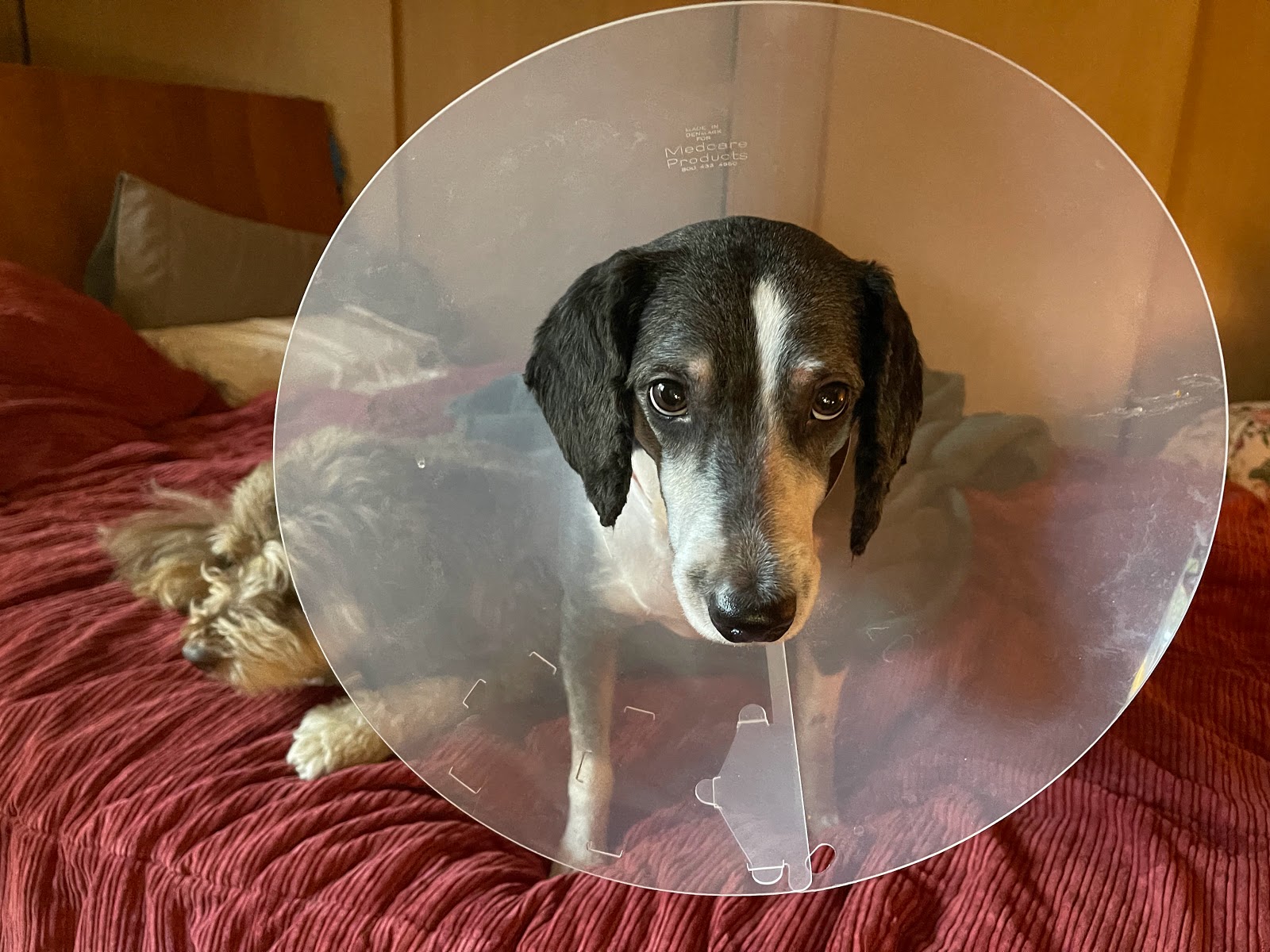
We had to get the Cone of Shame out of the garage. Buster is spending a few days relying on this plastic restraint to moderate his compulsive scratching – just like Papa fiddles with unfuzzy things to keep his hands away from his scalp. In the last few years I’ve learned a lot about impairments to both human and canine mental health. I’ve started to remove the cause. But not the symptoms.


Tuesday, March 10, 2020

Better-ish


As a Gay Sitcom Dad, I’m always in search of typecasting ideas. 

For example, a couple of years ago I wrote in “Tragedy Tomorrow” that most days I saw myself in striped pajamas as the Movie Dad from Life is Beautiful, shielding his son from the horror of the Holocaust. Only “once or twice a year” did I manage to achieve the ultimate parental glow:  on a particularly good day, I’d end a conversation with one of my children “feeling like Gregory Peck as Atticus Finch in To Kill a Mockingbird.”


In the last few months I’ve experienced another exponential improvement in my mental health. The timing is particularly fortunate – with the exception of five days’ respite over Winter Break, I've been a full-time single dad ever since my ex moved back to the Midwest in August.

Nowadays I can pull off ultra-sensitive single dad/lawyer Atticus Finch mode whenever I sit down for a soulful conversation with one of my children. But I like to mix things up. Some days I lean more toward Oscar Wilde – the world needs more Witty Gay Sitcom Dad. However, my fallback role is Jeeves. It’s best for everyone if my kids think of me as omniscient and omnicompetent.


Last Wednesday, Jeeves failed me completely. I was discussing the Olympics with my eleven-year-old son. He didn’t believe me when I insisted the Tokyo games will be held a couple of years from now, four years after the last Summer Olympics.

Later that day I had a similar conversation with one of the Baritones from Vancouver Men’s Chorus. We were trying to figure out when we sang “Love Shack” by the B-52s. By my mental calculation it was a couple of June concerts ago. Not four.

I was absolutely convinced it’s been two years since VMC’s “Road Trip” show and the Rio de Janeiro Olympics. Fortunately Jeeves and I didn’t bet anyone a new X-Box.


This strange two-year gap in my internal chronology shouldn’t come as a complete surprise. Here’s what I wrote a couple of years ago in “Woke”:

I am currently living in my own Hallmark Christmas movie.

Last Christmas is a blur. I retained only a couple of memories from last year’s VMC concert. Mostly I hid in dark corners. Indeed, most of 2015 - 2017 is lost in a fog. After increasing frustration with practicing law and raising kids in Seattle, I grasped at the false hope of moving to Bellingham for my dream job. Instead, a tragic confluence of bad choices, bad luck, and bad people destroyed my life. 

This Christmas is different. I can tell I've turned an important corner in the last few months. My mental health is noticeably better – not just the wearying projection of normalcy, but my actual mental health. I get out of bed and do stuff. The kids are thriving in Bellingham. I voraciously read and write again after years of drought. Things make sense for the first time in decades. Although I miss my faraway friends from earlier epochs, I’m putting down roots and making friends again. Not only did I enjoy singing in VMC’s holiday concerts, but I finally overcame my anxiety over socializing with all those nice Canadians just across the border. (They’re mostly harmless.) I even managed to sing a fleeting faux-Jewish solo without melting down.

It’s like I woke up out of a coma just in time for Christmas Eve. A holiday miracle. 

This is the point in the Hallmark Channel movie where everyone hugs and cries. Then I ask, “So what did I miss?”


What feels different this time is the rest of the fog has lifted. The scariest part of living with mental illness is when you know you’re not yourself. Anhedonia smothers you like a blanket, and loved ones describe strangely uncharacteristic behaviors you don't remember.  

Now I feel like myself, even when I feel unwell. The good news is that most of my fuzzy memories have finally snapped into place. The bad news is that my brain concluded the simplest way to adjust my internal clock was to delete two years from the timeline. It’s sorta like switching to Daylight Savings Time. Or like when England converted from the Julian Calendar to the Gregorian Calendar, and eleven days were dropped from September 1752.


So how am I doing with some of the other challenges I’ve described on this blog? For one thing, telephone customer service representatives across North America and the Indian subcontinent can rejoice. They don’t push my buttons anymore.

As longtime readers will recognize, this change is a big deal. Numerous early blog essays were devoted to my horrifying experiences dealing with Comcast’s wretched customer service. In contrast, for the last month I’ve been struggling to get my mother’s iPhone connected to the rest of us as part of Apple’s byzantine “Family Sharing” program. So far I’ve had five long telephone conversations with Apple technical support, as well as exchanging numerous emails. 

As my parents can attest, I’ve calmly handled the entire Kafka-esque experience. At one point, someone from Apple sent me an email suggesting that I log out of my own AppleID, and log back in. The next time I spoke with a technician on the telephone, she gasped and said “ooh, that was a bad idea.”

According to Apple, my mother will only have to wait another two weeks to access the family music account. At least she can now check Facebook and Fitbit again. Meanwhile I still can’t get my laptop, iPhone, and computer to synch. But somehow life goes on.


There’s been much less progress with some of my other PTSD-amplified anxiety symptoms. For example, I still struggle with serious bruxism, i.e. teeth-grinding.  

A few months ago, the pain in my jaw was excruciating. For the first time in my life, I scheduled a nonregular dentist appointment. I was convinced that I needed a replacement filling or a root canal. Fortunately, the X-ray didn’t reveal any serious problems. Unfortunately, my teeth grinding is out of control once again. Meanwhile, our dog Buster chewed up my night guard along with several more pairs of socks and underwear. 

So for Christmas my parents got me socks and a new night guard.


My daughters were born two weeks apart. Rosalind was adopted three and half year after Eleanor’s birth, and the girls have zero in common biologically, physically, or otherwise. We have an unusual hashtag in our family:  #NotTwins. For example:

Last month, one of my daughters sat me down and said “Papa, you realize you’re supposed to look people in the eyes when you talk to them, don’t you?”

Later that same week, my other daughter hugged me and said “Papa, I’m glad you don’t stammer when you’re home with us.”

I use the catchall phrase “social anxiety” to refer to various overdetermined layers of tics and behaviors. Some of mine relate to codependency, which my insightful Bellingham physician Dr. Heuristic identified four years ago when he diagnosed me with PTSD. Fortunately, I’ve successfully faced codependency after years of Codependents Anonymous and other treatment steps. Even the most relentless narcissists from my prior life finally realize I’m not going to return their texts and give them one more chance.

Other social challenges result from the tyranny of the closet and the lingering effects of trauma. As I wrote in “Avoidant,” most theories of human psychology, from Freudian analysis to Cognitive-Behavioral Therapy, place great weight on what we avoid. Avoidant thoughts and behaviors indirectly reveal how our mind works, or doesn’t work. As I gradually sift through layers of painfully repressed memories, I’m increasingly able to interact with other people.

Finally, some of my social quirks are just part of my personality. But they’ve always been heightened in predictably stressful contexts, such as miscarriages of justice, or spending time around other gay men. As I wrote last month in “Artificial Emotional Intelligence,” this has been one of the biggest challenges I’ve faced over the last four years: 

PTSD had the effect of moving me several notches further away from “normal” on the autism spectrum, particularly in my interactions with other gay men. I’ve lost much of my already dubious ability to read ordinary social cues. Faces are a blank. Nowadays I can’t tell if someone is hitting on me, or challenging me to a duel.  

Lately I’ve been reading John Elder Robison’s book Be Different: Adventures of a Free-Range Aspergian. I can relate to many of his tales and tips about life as a social misfit. On the other hand, the recent improvements in my mental health have included exciting progress in this area. I recognized my biggest breakthrough a couple of weeks ago, when I was treated by 911 medics and sent to the hospital for the first time in my life. (A bunch of fierce Canadian drag queens pushed me down the backstage stairs at the Granville Island Revue Stage. Allegedly. It’s a complicated story. You’ll have to read “Falling Can Be A Drag” for yourself.)


When abusive treatment by my new Bellingham employers first triggered strange new anxiety symptoms, the most visible sign was a dramatic increase in my formerly mild case of trichotillomania – the compulsion to pull out your hair. I began ferociously rubbing my forehead and yanking out what's left of the hair above it. Most of the time I’m unaware it’s happening. By the end of particularly stressful days, my scalp is raw. To mitigate the effect, I learned to fiddle instead with over-sized pipe cleaners – “fuzzy things.”

Ironically, my trichotillomania is worse than ever. I’ve exhausted the supply of fuzzy pipe cleaners at the Michael’s craft store in Bellingham. So I may have to plan a special trip to Seattle this week, just to stock up on fuzzy things and coronavirus supplies. 


If you insist on searching for a silver lining in the plagues I’ve endured over the last four years, particularly the impact of Post-Traumatic Stress Disorder (or rather the impact of my former employers’ horrifying treatment that triggered PTSD symptoms), there is one obvious candidate:  my new-found freedom from decades of debilitating writer’s block. If nothing else, writing has been essential to each improvement in my mental health.

However, I’m tempted to argue the most important change has been to transform my trauma-inspired “fixed mindset” into a “growth mindset.” Here is psychologist Carol Dweck's definition of each type of mindset:

In a fixed mindset, students believe their basic abilities, their intelligence, their talents, are just fixed traits. They have a certain amount and that's that, and then their goal becomes to look smart all the time and never look dumb. In a growth mindset, students understand that their talents and abilities can be developed through effort, good teaching and persistence. They don't necessarily think everyone's the same or anyone can be Einstein, but they believe everyone can get smarter if they work at it. 

One image from Dweck’s book Mindset sticks with me. It comes from her description of a child psychology experiment. Researchers can accurately distinguish between students with a fixed mindset and those with a growth mindset by assigning each child a set of challenging brainteasers. In my mind, Dweck’s example of the boy with a fixed mindset sounds just like my son now, or me for three decades – wearily sighing at the prospect of work and failure. In contrast, Dweck’s growth mindset youth rubs his hands together and exclaims “I love puzzles!” 

Being forced to deal with one real disaster after another over the last few years eventually taught me how to bounce back from repeated failure. Life is good and getting better. Still, I hope my PTSD-induced symptoms will go away someday. Maybe I will be magically cured once my villainous abusers finally take responsibility for their actions. Or when the courts order them to take responsibility. I know it’s just a theory, but humor me. 

Nevertheless, if losing two years of my life and pulling out my hair every day forever are the worst things that ever happen to my family, I’ll take it.


Previously in Rock Bottom Stories: “Maximum Leverage.”   Next: “Least Gay Great Day Ever.”