Showing posts with label Rock Bottom. Show all posts

Thursday, December 1, 2022

Anesthesia

Eleanor at Whidbey General Hospital with bacterial pneumonia

(pre-helicopter ride to Seattle Children’s Hospital)


Facebook can be horrifying. 


Several years ago, a friend posted a cheery selfie from his sunny hospital bed after a surprise appendectomy. A day later, someone else posted the report to Facebook that our friend had died from complications after surgery.


Eleanor after hip surgery

In February, Eleanor had a sports injury that didn’t heal. In October, she had arthroscopic surgery to repair a labral tear in her hip. I sat in the waiting room, trying to read or write while my daughter was under general anesthesia. 


I am not a superstitious person. But I didn’t post a picture to Facebook until after it was all over.


Eleanor spitting up

My first paternal vigil was at Seattle Children’s Hospital in 2005. When Eleanor was a month old, her infant gastric reflux spiked. Whole bottles of formula ended up on her fathers, and she stopped being her happy self. Our pediatrician assured us this was perfectly normal. But it kept getting worse. Eventually we took her to the walk-in clinic. They immediately sent us across town to the emergency room at Seattle Children’s Hospital, where Eleanor was diagnosed with pyloric stenosis.


The pylorus muscle connects your stomach to your intestines. It’s the valve at the opposite end of the stomach from the esophagus. In something like one in a thousand babies, the pylorus closes completely a few weeks after birth. Anything you try to put into the stomach just comes back up. In the old days, infants with pyloric stenosis soon died. Fortunately, a century ago surgeons figured out how snip the pylorus and get things flowing again.


It took three days in the hospital before Eleanor was hydrated enough for surgery. When she was finally ready, the surgeon explained to us what was about to happen. Then he and Eleanor disappeared behind the ominous doors, and the rest of us went around to wait on the other side.


Eleanor before stomach surgery


My friend Michael is a distinguished anesthesiologist. I met him when we served together on the Seattle Men’s Chorus board. Although Michael isn’t a singer, he traveled with the chorus on our successful Rocky Mountain tour. So did one-year-old Eleanor. Over the years, Michael has given his Facebook thumbs-up to countless pictures of my daughter as she’s grown into a graceful and confident young woman.


Michael is an avid traveler with long legs and an aversion to flying coach. Although I’ve been immobilized by parenthood and disability, I’ve traveled vicariously as Michael and his husband Ron voyaged across the globe. Michael regularly posts pictures to Facebook showing his legs happily extended in First Class, or begrudgingly squeezed into an economy row. Last month we saw a picture of Michael’s legs comfortably resting on a British Airways flight to Barcelona. He and Ron were on their way to board a cruise ship for a trip around the world in celebration of their 42nd anniversary.


The next day, Facebook reported that Ron suddenly collapsed and couldn’t be revived. As Michael himself reported, “The sad news has already been mentioned, but I’m devastated to say that with no warning, the Husband suddenly collapsed and couldn’t be revived by the valiant efforts of the Spanish paramedics. I’m now dealing with the local medical examiner, the US consulate and at least one funeral home. A million thanks to those who have reached out already.”


Michael is a social creature with countless friends. Ron was quieter. I mostly knew him from references to “the Husband” in Michael’s Facebook posts. However, I know anyone living and traveling together with Michael for decades will see wondrous things. Ron had a wonderful life, then a sudden death in Barcelona.


Michael managed affairs in Spain then returned to Seattle – terribly alone, yet surrounded by friends. Michael’s next Facebook post said “I’m absolutely gobsmacked by the outpouring of support and affection from hundreds of friends and family.” 


Eleanor after stomach surgery

Last fall I sat in another waiting room while our next-door neighbor operated on Eleanor’s nose to correct a deviated septum. (Another sports injury, don't ask.) Afterwards I came back to sit with her as she emerged from anesthesia. I had to sit for a while – they wouldn’t let her leave the building until her blood pressure came down. The nurse spiked her IV drip with a couple of different hypertension medications, to no avail. So she gave Eleanor a hit of fentanyl. 


It was eye-opening. For me, not Eleanor – I watched as her eyeballs rolled back and her blood pressure immediately dropped. In the car afterwards, Eleanor said she hated how the fentanyl made her feel, and she never wants to try anything like it again. 


As a parent, I found nose surgery provides a wonderful “Just Say No” moment.


Eleanor before last year’s nose surgery 


At Eleanor’s recent hip surgery, I was invited to the pre-op area as the nurses got her ready. Her handsome surgeon stopped by, too focused on business for the kind of charming chit-chat we enjoyed during our introductory meeting a few weeks before. 


Before returning to the waiting room for another paternal vigil, I also met the anesthesiologist. His spiel was soothing, but a little too polished. He told us the odds of complications were one in 250,000, and said Eleanor was at less risk during surgery than during her car ride to the hospital.


Never tell me the odds. As I observe Michael grieve the sudden loss of The Husband after forty-two years together, I think of my sister-in-law in Canada, who sleeps on the couch across the living room from the hospital bed where my younger brother is confined by Stage IV spine cancer. And I watch my parents across town growing old together as they celebrate their 60th anniversary next year. 


I’ve been a failure with romance myself. By most measures I’ve been a failure with everything else. Instead, I’ve poured my heart into fatherhood. 


Wherever we find love, probability is not destiny. Life is fragile and precious, with no guarantees. And no day but today.


Eleanor before this year’s hip surgery


I recently read Pathological: The True Story of Six Misdiagnoses by Sarah Fay. The New York Times Book Review described the book as a “fiery manifesto of a memoir.” Like other critics of what has been called the “Mental Health Industrial Complex,” Fay challenges two dangerous aspects of modern psychological treatment. First, too much weight is given to the Diagnostic & Statistical Manual’s taxonomy of specific mental disorders. The DSM began as a helpful resource for practitioners. Unfortunately, its rigid categorizations can take on a life of their own, usually without the support of valid data. Rather than being seen as individuals, patients are reduced to labels and insurance codes. 


Second, market forces and Big Pharma have corrupted medicine. Pharmaceuticals became the default answer to every mental health question, causing numerous disasters including the opioid epidemic. In Fay’s case, her fifth psychiatrist prescribed Zoloft along with a new diagnosis. No one knows what powerful drugs like Zoloft and Prozac actually do to the human brain. For many individuals – including Fay and me – Zoloft offers magical relief to various debilitating symptoms. For other individuals in similar circumstances, the same drug may have no effect.


I was lucky. As I wrote in “Breaking the Glass,” I like to compare Zoloft to cartoon dynamite. The most alarming effect of amped-up stress had been on my temper around the kids. Every little mess was making me uncharacteristically angry. On medication, my fuse feels a few inches longer. Just enough to avoid explosions.


When Fay’s next psychiatrist gave her a new diagnosis, he insisted she end her reliance on Zoloft, because the drug was no longer indicated as part of standard treatment. Fay gradually tried reducing her dosage. But every time she approached zero she was wracked with horrifying withdrawal symptoms. She needed to stay on Zoloft to avoid side effects she never experienced before someone prescribed Zoloft for one of the six serious DSM diagnoses she received (none of which involved traumas or triggers). 


Eventually Fay took control of her own treatment: 


“I found the right combination and dosage of medications, which is like finding the slimmest of needles in the largest of haystacks at the end of a rainbow after winning the lottery.”


Eleanor after being airlifted to Seattle Children's Hospital

For years, I relied on the maximum dosage of 200 milligrams of Zoloft daily. A couple of years ago my amazing Bellingham physician Dr. Heuristic and I agreed it was time to taper down. I plateaued at 100 milligrams for a few months. Then I made it down to 25 milligrams. However, every time I considered letting go completely, some new life crisis erupted, and I would lose my nerve. 


This year began with the usual stress at home and in the world, plus crises and/or disasters in several of my ongoing legal matters. Nevertheless, I decided it was time to let go of Zoloft. Fortunately, unlike Fay, I didn’t experience withdrawal or side effects. 


In his classic treatise on trauma and its effects, The Body Keeps the Score, psychiatrist Bessel van der Kolk levels some of same criticisms at his profession that Fay addresses in Pathological. Dr. van der Kolk observes “people have always used drugs to deal with traumatic stress,” and recognizes pharmaceuticals are an essential treatment tool. Nevertheless, in the particular context of Post-Traumatic Stress Disorder and Complex PTSD,


Drugs cannot “cure” trauma: they can only dampen the expressions of a disturbed physiology. And they do not teach the lasting lessons of self-regulation. They can help to control feelings and behaviour, but always at a price – because they work by blocking the chemical systems that regulate engagement, motivation, pain, and pleasure.


Since my PTSD diagnosis, I’ve spent thousands of hours meditating. Through writing I’ve learned to think clearly. I’ve finished a broader and more substantial psychology and neurology reading list than most grad students. Bear and I walk six or seven miles every day. I had a 3.7 Wordle average in November. I spend as much time as possible in Vancouver with my chorus brothers or walking on the Stanley Park seawall. I’ve placed my family at the center of everything. 


After letting go of Zoloft, I was able to open myself up to tears of joy and sorrow. Of course, this also means that my emotions are more vulnerable to stress and triggers. I’m an unemployed disabled gay single dad who lives across the border from home. Every day I deal with triggering conduct by abusive lawyers. It should come as no surprise that even with the benefit of my shiny set of mental tools, my family has observed some fuse-shortened emotions lately.


I don't want to go back on Zoloft. So Bear and I are going for another walk.


Sunday, June 19, 2022

Infinite Joy


Yesterday I received the nicest compliment ever. 


It was closing night of a successful series of Vancouver Men’s Chorus concerts entitled "R-E-S-P-E-C-T: Celebrating Women's Music." Afterwards a woman came up to me in the parking lot on Granville Island to say how much she enjoyed watching my face during the performance. She said, “Years ago in high school, my choir conductor kept telling us to smile. Now I know what he meant.”


I said thank you, and told her they were a great audience. Then we discussed how the first tenor next to me had the second-brightest smile in the chorus – so maybe our conductor Willi should consider spreading the joy and separate us a little. (Not coincidentally, when an elderly couple came up to compliment my smile after an earlier performance, they said the nearby “Asian guy” and I seemed to be enjoying ourselves more than anyone else on stage.)


The reason our gushing patrons noticed my smile was because despite many challenges these days I’m happy, the kids are alright, and I’m enjoying the best mental health of my life. It shows.


More importantly, they were able to observe my freakishly expressive face because I stood in the front row. Previously the combination of anxiety issues and terrible dancing would have protected me from being placed in such a vulnerable and exposed position. In fact, after twenty-five years singing in gay choruses, Willi was the first person to put me in the front row of anything. 


I joined Vancouver Men’s Chorus in January 2016, just two months after the shock of being diagnosed with Post-Traumatic Stress Disorder. Abusive workplace dynamics at my new job in Bellingham had triggered a host of strange new anxiety symptoms. A few months later, they fired me based on my disability. This further exacerbated my injuries, and exposed long-avoided psychological fault lines. Rock bottom occurred during my first year in VMC. 


I spent the last six years slowly rebuilding my mental health, while simultaneously dealing with distractions like raising three kids during a pandemic and suing my former employer. At this point I accept that many of my tics and twitches will never go away. Fortunately, I’ve learned to recognize triggering situations, identify reasonable accommodations, and mitigate the impact of trauma. 


Meanwhile, I’ve finally begun making progress on the social aspects of my disability. Before getting the correct trauma-based diagnosis, I used to think I was just a typical introvert who struggled with social anxiety. Now I recognize that even without the effect of trauma I would still be neurodiverse. I could have grown up to be the gay English Major version of Sheldon from Big Bang Theory. Trauma merely bumped me a few notches further along the autism spectrum. As a result I’ve lost much of my already dubious ability to read ordinary social cues. Paradoxically, despite having an exceptionally expressive face myself, other people's emotions remain a mystery. I can’t tell if someone is hitting on me, or challenging me to a duel. So I mostly stay quiet. 


As I faced various challenges over the last few years, Vancouver Men’s Chorus provided my greatest lifeline other than my family and my writing. In particular, VMC allowed me slowly crawl out of my shell in the safest possible corner of humanity: a gay Canadian choir. 


Ironically, however, my disability disproportionately affects my relationships with other gay men. When I began singing with VMC, I was practically catatonic – barely able to engage in any social interactions, and completely unable to speak to strangers. I was also essentially face blind. Eventually my brain started adapting. But it still played weird tricks, like remembering guys only as cartoon characters. Then covid closed the border and silenced choirs for a couple of years.


Fortunately, by the time the border reopened and we began rehearsing again last fall, I was thinking much more clearly. I could finally tell guys apart. But I still have problems with basic things like eye contact, and knowing when to start or stop talking. So I seldom initiate conversations with anyone other than the handful of other tenors I’ve known for years. Socially I’m like a vampire – someone else has to be the one to open the door and invite me in.


One way to measure mental health progress is to compare the story of my smile. Five years ago, I published “If You Just Smile” after my very first VMC concert. The opening anecdote was eerily similar to this years essay:


Vancouver Men’s Chorus recently finished a successful run of concerts on Granville Island. After one of our final performances, a middle-aged straight couple came up to me in the lobby. They both loved our show, and gushed about the marvelous singing and entertaining dancing. They sought me out afterwards to say “You had the best smile! Only a few of you up there looked like you were having fun the whole time, but you definitely did!”


I get that a lot. I have a mime-ishly expressive face, often without realizing it. (Sometimes your eyes just roll.) After forty years of performing, I’ve embraced numerous directors’ and conductors’ admonition to let the audience see you are enjoying yourself. But I smile almost all the time offstage as well. Everyone says my smile is my best feature. Seriously – eHarmony has statistical data proving this. … 


If that straight couple had come to opening night of the recent Vancouver Men’s Chorus concert, I know they would have loved the fun but less polished show. They might have not noticed me fiddling with fuzzy green things offstage to distract myself from pulling my hair out. But unless they are both legally blind, they would have seen the smile of an anxious second tenor overwhelmed by the scrum of gay men backstage, and remembering such a low percentage of his choralography he should not be placed in the front row. Ever again. Hint, hint.


“If You Just Smile” told the story the story of how my personal traumas began. When I was a teenager, my family moved from Vancouver to a repressive Mormon small town in Utah. I got the nickname “Smiley” from my bullying classmates. I began compulsively clenching my teeth and smiling because I knew if I started to cry instead I would lose it all. I spent the next thirty years blinding people with that same smile, regardless of whether it was real.


At my first VMC concerts my smile was just as bright before and after I learned the choreography. But Willi sensed my discomfort, and never put me in the front row again until this year. 


Elton & Rina singing "Chosen Family"


As I wrote last week in “True Stories,” an evening of gay men singing songs by and about women requires a little extra context. Willi therefore asked for volunteers to introduce several of the numbers with personal stories about their connection to the songs. I was one of three singers who introduced the song “Chosen Families.” It wasn’t a diva solo or flashy dance number. But it came at the emotional climax of the concert.  


Willi is an expert at guiding audiences on an entertaining and cathartic journey. Sure enough, each of our three very diverse stories about chosen families left the audience and chorus in tears. Paul told about how he and his husband Gerry moved to Vancouver from the U.K. and found a home with the chorus. Two years ago, Gerry died of cancer in Paul’s arms, surrounded by friends from VMC. I spoke about being both a PFLAG son and a PFLAG father. 


Yogi’s story is about how he came from Indonesia to Vancouver at 18 knowing only two words in English. His biological family had given him two months to choose between “stop being gay” and leaving the country. Now Yogi is a pillar of the arts and queer communities, and President of VMC.  


So how did I end up smiling at the audience from the front row?


Yesterday between shows, Willi asked me whether I enjoyed my experience standing in the front row. I explained that my “Executive Function” had been challenged by the cumulative effect of multiple stressors, including kids, legal work, commuting from another country, foreign language memorization, and – my traditional nemesis – choreography. But I survived. 


I also told Willi about the audience members who had complimented me on both my speech and my smile. Willi was pleased. He said he was confident I would have said something to him if I thought I couldn’t handle the pressure.


As a writer and a lawyer who has cross-examined numerous witnesses, I have an acute built-in bullshit detector. This set it off. Willi is a brilliant conductor and programmer. He is also one of the most Canadian people I know other than myself. This means he’s preposterously kind and nice, but also passive-aggressively manipulative and ruthlessly efficient. 


Over drinks at PumpJack last month, I already told Willi about my first-row struggles. He said he would change the configuration at the next rehearsal. Then he “forgot.” It wasn’t merely his glass of wine. During that conversation, alarm bells also went off when Willi explained I belonged in the front row because of my “height.” I sing in a gay choir filled with Asian tenors. Lots of guys who are just as tall or shorter than me spent the concert safely hidden on the second row. 


But I forgive Willi for pushing me a little, and thank him for the opportunity to share my story and my smile.  


Here’s how Yogi began his speech:


“People ask why I’m always smiling. I guess it’s because I’m so happy.”


Yogi’s and my blinding smiles each began in trauma. But now they’re real. And according to the woman who complimented me after the last concert, she could feel our joy.


Sunday, February 27, 2022

Nurses are Fiercer than Drag Queens


As we inch towards a post-pandemic New Normal, the entire Vancouver Men’s Chorus is finally gathering to rehearse together again on Wednesday evenings. Our June show on Granville Island, “R-E-S-P-E-C-T,” will be a salute to women’s music. We started learning the same songs two years ago, before the coronavirus pandemic silenced choirs and closed the Canadian border for the first time since the War of 1812.


The week before the border closure, I was in Vancouver for VMC’s annual fundraiser “Singing Can Be a Drag.” I’ve never done drag myself. Instead, I was a volunteer usher.


In addition to avoiding high heels, prior to February 2020 I also had never lost consciousness. The last thing I remember about the drag show is the lights dimming at the beginning of the queens’ performance. I’m told I fainted and fell down the stairs backstage soon afterwards. As I wrote in “Falling Can be a Drag,” I still can't remember anything from the rest of the night, including the hot fireman who arrived to minister to me after someone called 9-1-1. (Inevitably, VMC President and uberextrovert Yogi Omar ended up with the medics telephone number.)


Back home in Bellingham the next day, I woke up feeling sore all over without knowing why. When I returned Yogi’s frantic “how are you feeling???” text, I discovered what happened the night before. So I drove across town to the walk-in clinic. After the nurses heard my story, they made me walk across the parking lot to the Emergency Room at Saint Joseph’s Hospital for an ECG and CT scan. 


None of the tests revealed anything abnormal. My excellent physician Dr. Heuristic eventually concluded the episode was a stress-related manifestation of my disability, triggered by particularly intense emotional experiences. 


A random convergence of legal, medical, family, and financial crises made the last few days my most stressful and triggering week ever. 


On Wednesday I was in Vancouver on my way to chorus rehearsal when I lost consciousness for the second time in my life. However, instead of drag queens, this time I had the good or bad luck of fainting in front of a couple of nurses while visiting my brother on the spine floor at Vancouver General Hospital. 


Leishman Brothers:  Brian (lung cancer survivor); Roger (PTSD); Warren (bald); Doug (spine cancer)

My next younger brother Doug was diagnosed with spine cancer five years ago after back pain revealed an inoperable tumor. As the heaviest Leishman brother, Doug was defensive about failing to notice a grapefruit-sized lump in his pelvis: “They’re big bones!” 


Despite many challenges, Doug is blessed with the best family in the world, marvelous medical providers, and Canada’s sane healthcare system. He was able to walk my eldest niece down the aisle at her wedding two summers ago. Since then, Doug has spent most of his time bed-ridden at home in British Columbia. This month he was airlifted to VGH for nine hours of emergency surgery after a growing neck tumor paralyzed his upper body. The surgery went well, and Doug is learning how live with a wheelchair. 


Our family has observed numerous parallels and contrasts as my brother faced cancer at the same time as I was learning to live with mental illness on the other side of the border. Last Wednesday, I arrived late to visit Doug in the hospital after spending my morning writing a particularly stressful letter to the State’s lawyers in response to their continuing refusal to acknowledge that I have a disability. My stress was further exacerbated by the fact that the judge in my lawsuit against the Governor’s Office had scheduled an inevitably triggering hearing for Friday morning.  


While visiting my brother’s hospital room and listening to a discussion of pain management, I became lightheaded and collapsed to the floor in front of two nurses. I thought it was just a low blood sugar moment. The nurses quickly placed me in a wheelchair and gave me apple juice. I was pale and clammy, with a slow heart rate, but still alert. Until yesterday, I’d never had an even slightly elevated blood pressure reading – I inherited my father’s high cholesterol, not my mother’s hypertension. However, one of the VGH staff said she had never before seen a blood pressure reading where both the numbers had three digits. 


Other than losing consciousness in the wheelchair after they checked my vital signs, this time I remember the rest of the experience. Despite the melodramatic interruption, Doug said it was educational to watch me pass out. My sister-in-law told us I looked just like my brother when he overdoses on morphine. 


There are both advantages and disadvantages to passing out in a hospital. Rather than attend chorus rehearsal, I spent Wednesday evening at Vancouver General being tested and observed. 


Once I regained consciousness, one of my brother’s nurses insisted on wheeling me through a backstage maze to the ER waiting room. By the time she handed me over to the triage nurse my vital signs had all returned to normal. A technician wired me up for a quick ECG and assured me my heart looked fine. 


At this point they took away my wheelchair and sent me back to the ER waiting room, where I found my efficient sister-in-law on the phone finding me a place to stay overnight. Then the nice Canadian nurses tricked us. They led me down a hall to finally get my insurance information, something that happens much earlier in the process in the States. 


It could have been another triggering situation – trying to communicate about a stressful topic through a plexiglass screen while wearing masks. Fortunately, although English was not her first language, this was hardly the first time she had filled out the paperwork for an unfortunate American finding himself trapped in the province’s largest hospital.  


“Trapped” is the right word. After I signed a bunch of forms without reading them, she led me alone through a new set of doors to the secret inner waiting room.


Someone politely drew a few vials of blood. I texted my sister-in-law and told her I’d been kidnapped. Then I found a chair in a waiting room filled with sniffling children, Asian grandmas, and moaning hockey players. 


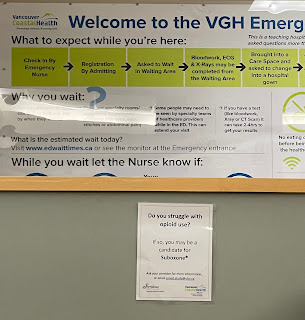
As I looked at my new surroundings, I took a picture of the sign above the chair directly across from me. It asked:  “Do you struggle with opioid use?” Ironically, this is what the nurses were talking about in my brother’s hospital room when I fainted. As Doug says, the best thing about having cancer is that even in the middle of a fentanyl public health crisis you get as much morphine as you need. Too much, in fact.


Eventually I got a text back from my sister-in-law saying “Wrong number.” Apparently her contact information in my iPhone was out of date. Unfortunately, this was also the only phone number I’d given to the hospital staff.


Fortunately, I was finally able to reach my parents. They hadn’t answered my previous calls because they were busy driving my college freshman nephew to the ER in Bellingham. (He had a concussion. I still havent heard that story.) I tried to obtain my sister-in-law’s actual phone number from my mother without sounding too alarming.


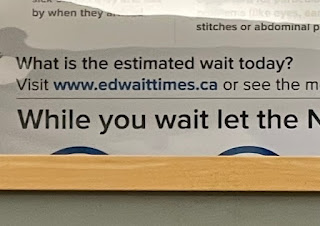
As a single parent, I’ve already spent too many hours in waiting rooms with a dying iPhone battery and nothing to do, eat, write, or read. Eventually I got bored and blew up the photo I’d taken of the “Welcome to the VGH Emergency Department” poster: 


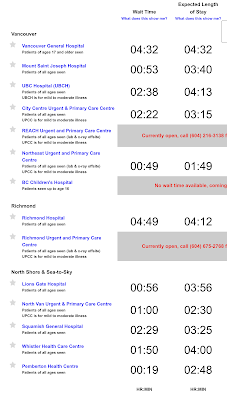
Modern technology is amazing. As directed by the poster on the wall, I clicked on the link “edwaittimes.ca” and discovered the current wait time for each emergency room in British Columbia. Unsurprisingly, Vancouver General Hospital has the largest and slowest casualty department in the province:


According to the website, I could expect to wait four hours and thirty-two minutes before getting my lab results and seeing a doctor. Perhaps coincidentally, I could expect to wait four hours and thirty-two minutes before escaping from VGH. I was almost halfway there.


Meanwhile, I hadn’t eaten for six hours. I could sense actual hypoglycemia on the horizon. VMC rehearsal was about to start without me. I was crabby. I’d left my library book, laptop, and phone charger in the car, which by now was illegally parked. My sister-in-law texted with an offer to bring me a snack from the hospital vending machines. I told her I’d been through enough triggering experiences for one Wednesday. 


When I was tricked into walking across the parking lot from the Bellingham walk-in clinic to the Emergency Room two years ago, the American nurses promptly put me into a hideous hospital gown and hooked me up to a heart monitor. Armed guards surrounding the hospital campus prevented any thought of escape.


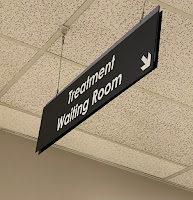
Everything is better in Canada. Despite my sister-in-law’s maternal sighs, I went AWOL. I used the last of my colorful foreign money to buy an invigorating milkshake and fries at Johnny Rocket’s. Then I moved my car to a nearby parking spot, grabbed my backpack, and snuck back into the ER treatment waiting room. No one noticed I was gone.


Drunk on chocolate milkshake and library books but completely sane and sober, eventually I decided it was time to drive home to my children. 


After more than five hours had passed, I went to the nurses’ station to tell them I was invoking the Geneva Convention and returning to the States. They pulled up my chart and pointed out I hadn’t seen a doctor yet. I promised to turn myself in to my physician in Bellingham. I asked if my bloodwork had come back. The nurse said it looked fine. 


After I self-helped myself to discharge from the ER, I found my way through the hospital maze back to the spine floor. My brother and sister-in-law were on the phone with my oldest niece and her wholesome BYU husband. Their baby is due this week. Last month her brother and his wholesome BYU wife passed them by producing the first great-grandchildren – identical twin boys. Despite the tragicomic plagues that beset us, my family is eternally blessed. 


So far I’ve been to five Canadian province (British Columbia, Alberta, Quebec, New Brunswick, and Nova Scotia). How many states have I visited?


Business travel and multiple cross-country moves got me to the low forties. Then a decade ago I represented the Gay Softball World Series in a First Amendment case that involved deposing LGBT athletes across the nation. On just one trip I crossed off Arkansas, Mississippi, and Georgia. I also changed planes in Birmingham, but never left the airport. After my law school twenty-five year reunion in 2015, I rented a car and finally road tripped to Vermont, which brought me to forty-nine states. Fifty if you count Alabama.


In my first blog essay about our family’s devotion to the PeaceHealth walk-in clinic, “Dr. Practical,” this is what I presciently wrote:


I've managed to avoid hospitals for fifty-five years. In particular, as long as I retain any voluntary muscle function, I’m never going to be sick enough to go to an emergency room. Fortunately, being surrounding by loving family means that if I really needed medical assistance, someone will take me to the ER as soon as I lose consciousness. Then the ER stops being an indefensibly profligate expense. 


Six months later, a gaggle of Canadian drag queens pushed me down the stairs. The next morning the nurses at the walk-in clinic tricked me into walking across the parking lot to the Emergency Room to get my heart and brain examined. At the American ER, they stripped me and tied me to a hospital bed. 


This week the Canadian nurses were much nicer. Still, they were the ones who wheeled me to the ER after I lost consciousness, with my brother and sister-in-law egging them on. If that counts as “going to an emergency room,” then I’ve also been to Alabama and get to cross off all 50 states.


Tuesday, September 21, 2021

I am Karen


Last week one of my healthcare providers and I were chatting about the challenge of explaining Post-Traumatic Stress Disorder to people, particularly when you don’t seem like a typical victim. 


PTSD can happen to anyone. Trauma tangles the neural wiring that connects a wide variety of brain functions, including memory, fear, rage, reason, and motor control. Two people can endure the same traumatic event or experience, but only one might develop PTSD. Days or years later, you might encounter a particular feeling, person, or experience that flips the switches in your brain and triggers a cascading response from your body.


One of my friends in Bellingham developed PTSD after serving as an Army Ranger medic in Afghanistan. I told him I feel sheepish sharing the same DSM-5 category as him. He told me not to worry, and that soldiers feel lucky they get so many folks’ respect. They’re more concerned about the many children and women who are scarred by the impact of domestic abuse and do not have access to the help they need. 


In November 2015, my Bellingham physician Dr. Heuristic sent me to a specialized PTSD therapist. She helped me identify how my symptoms were rooted in traumatic events I experienced thirty years earlier as an overachieving gay student at Brigham Young University and as an earnest Mormon missionary in Korea. 


In my recent blog essays “Move On” and “Blink,” I described the Mormon church’s relentless campaign against LGBT dignity and inclusion. Throughout my lifetime, Mormon leaders have insisted on embracing junk science, such as pray-the-gay-away “reparative therapy.” Perhaps most insidiously, the Brethren deny our very existence – refusing to use words like “gay,” “lesbian,” or “transgender,” and instead insisting we’re merely weak sinners who struggle with what they refer to as “same-sex attraction problems.” When you also consider my family’s wrenching move from Vancouver to Utah when I was an adolescent, plus my coming out as a gay man at the height of the AIDS pandemic, it’s no wonder I ended up with PTSD.


Because of the nature of my underlying traumas, my most serious individualized PTSD symptoms are triggered when I feel a sense of powerlessness, repression, being silenced, or rendered invisible once again. As result, my disability makes me particularly vulnerable to gaslighting lawyer tactics. 


Looking back at my writing about mental illness over the last four years, I realize I’ve focused primarily on the physical symptoms, such as trichotillomania, insomnia, and bruxism, that emerged after my abusive former employers triggered my body’s response to ancient traumas. Because of Defendants’ and their co-conspirators’ subsequent misconduct and their continued stonewalling delays, I remain trapped in a vicious cycle of stressful triggers, re-traumas, and re-triggers. I’ve written about the resulting plagues of boils, MRSA, auto-immune dysfunction, depression, anxiety, but not frogs yet.


I’ve also referred several times to triggers leading to “PTSD episodes,” but I haven’t yet described the mechanics of the experience. In some ways it’s like the arrival of a migraine – you realize it’s happening, but there’s nothing you can to do to stop the buzzing and pressure on your brain. Soon it becomes impossible to think and communicate clearly. 


When I began reporting about life with mental illness, my examples of PTSD episodes all involved wretched customer service. I had a short fuse, and I ran into a lot of bad service. Eventually I learned to modulate my reaction to frustrating encounters. Now I react excessively only to terrible service with a reality-denying totalitarian bent, not your day-to-day consumer abuse. For example, just last week I made an embarrassing scene in a bank lobby. Not my fault.


When my disability was still new, I was constantly surprised by the wide variety of triggering events that somehow resonated with my thirty-year old traumas. Things have mellowed since then. My biggest PTSD epiphany this year came when I was playing a family board game at my parents’ house, and I became so frustrated I had to go into the other room and give myself a timeout. (It turns out there are trauma-based reasons I haven’t been able to play chess since I was a child, much to my son’s disappointment.)


Despite the progress I’ve made with my disability, I continue to endure another very predictable trigger:  gaslighting lawyers. In May 2017, I filed a lawsuit in state court against the attorney-investigator firm my former employers hired to cover up my wrongful termination. Attorney General Bob Ferguson assigned two lawyers from the Attorney General’s Tort Division, Assistant Attorney General Suzanne LiaBraaten and Assistant Attorney General Janay Ferguson, to represent the State’s interest in the investigator lawsuit. Ferguson and LiaBraaten obstructed discovery, made frivolous privilege assertions, and abused the legal process. In 2019, Ferguson and LiaBraaten violated the Ethics in Public Service Act and the Rules of Professional Responsibility when they made false representations in their co-workers’ lawyer discipline proceeding. Ferguson herself is the subject of a pending ethics complaint, and is a named defendant in my federal lawsuit against the State and its representatives. 


Nevertheless, Attorney General Ferguson insisted on assigning Defendant Ferguson as lead counsel on behalf of the other defendants in the federal lawsuit. Her conduct of the litigation has been an outrage. Here’s what I said in a sworn declaration about how it feels when dishonest government lawyers trigger a PTSD episode:


Responding to the first motion Defendant Ferguson filed in my federal court case one year ago was one of my most harrowing experiences in years. For every ten minutes I spent working on the brief, I had to spend at least an hour on soothing activities like talking with my children, walking the dogs, meditating, exercising, etc. Now that my kids are back from visiting my ex during the summer, the presence of other observers in the house makes my AGO- triggered PTSD symptoms even more noticeable. Over and over as I was forced to confront the State’s lies, I would read or write a single sentence. Then I would compulsively leap out of my chair and pace ten or twenty laps around the house, grinding my teeth from bruxism and rubbing my scalp raw from trichotillomania. When my teenaged daughter who wants to go to medical school heard my involuntary wheezes and groans, she thought I was having a heart attack. 


Every one of Defendant Ferguson’s court filings and each of her communications to me over the past year was triggering. (Fortunately, her good cop co-counsel politely handled all the administrative stuff.) For example, on multiple occasions she took the position on behalf of the State of Washington that for the last six years I’ve been faking a disability to cover up for my professional incompetence and my sexism.


I asked the State’s lawyers to accommodate my disability by assigning a lawyer other than Defendant Ferguson to communicate with me. They refused. Eventually I asked the judge to order this reasonable disability accommodation. On September 15, 2021, Judge Jones granted my request. I felt a huge weight lift from my shoulders.


Defendant Ferguson’s counterpart in my state court lawsuit against the private investigator firm is Claire Martirosian, a junior partner at the grinding insurance defense firm whose apparent goal is to provoke me into pulling out the last hair on my forehead.


Ms. Martirosian has been involved in the case ever since the summer of 2017 when the investigators fired their first, even less smart insurance defense firm. In contrast with the division of labor between the boy-girl legal team in my federal lawsuit against the State, Ms. Martirosian is handling everything solo. That means she plays both the good cop and bad cop roles. In “Secret Agent,” I wrote about how Ms. Martirosian triggered a PTSD episode in the middle of oral argument in the Court of Appeals two years ago when she blatantly lied in response to the key question from the bench.


Last Friday two letters from Ms. Martirosian arrived back-to-back in my inbox. The good cop first letter responded to the proposed deposition schedule I had circulated earlier in week. Of course Defendants didn’t agreed to the schedule, or propose an alternative. But the letter wasn’t triggering, merely another round of familiar litigation Kabuki.


In contrast, Ms. Martirosian’s bad cop second letter was a tissue of lies. She blatantly mischaracterized the Washington Supreme Court’s recent ruling, and triggered another PTSD episode.  Once again I alarmed the dogs by leaping out of my desk chair and pacing around the house. I lost count after 87 laps. 


If I were a Republican congressman, I could announce “As the father of two daughters, I condemn the Attorney General’s scurrilous accusations of sexism.” But I believe in mindfulness and empathy. When someone else’s model of reality diverges so far from my model (and from reality), I wonder why.

Here is Defendant Ferguson most recent accusation that I am an unrepentant misogynist:

Mr. Leishman elected not to respond to the Defendants’ requests for conferral because it was not made by the male attorney with whom he prefers to communicate…. Defendants will not recount the many, documented instances of Mr. Leishman’s personal attacks on Ms. Ferguson and other women, parties and not, attorneys and not, because that issue is beyond the scope of this motion. When they do, Defendants will submit evidence, not conclusory allegations, proving that Mr. Leishman disproportionately demeans, attacks, and underestimates women – particularly those who disagree with his subjective view of events. Avoidance of female counsel is not a reasonable accommodation.


Washington tax dollars paid for this deranged rant, which appears on page two of the State Defendants’ Reply in support of their Second Motion to Stay Discovery. 


My eyes were drawn to the word “disproportionately.” Perhaps Defendant Ferguson is referring to the fact that woman outnumber men in the captions of my lawsuits. That’s because most of the middle and lower level managers at the Washington Attorney General’s Office and other State agencies are women – but all the top brass are men. The federal defendants include the office of Governor Jay Inslee; the office of Attorney General Bob Ferguson; Bob’s two top lieutenants, the Chief Deputy Attorney General (Defendant Shane Esquibel) and the Solicitor General (Defendant Noah Purcell); and the former president of Western Washington University (Defendant Bruce Shepard). These important gentlemen are joined by seven female underlings who personally interacted with me or were directly involved in misconduct and coverups. Only one defendant is actually named “Karen.” I could have sued two more female defendants, my unprepared novice “Team Leader” and her passive-aggressive supervisor. But I don’t need to make everything personal.

Behind every powerful man is a harem of less powerful women. Look at Jeffrey Epstein and Ghislaine Maxwell, or Andrew Cuomo and Melissa DeRosa. One definition of a “Karen” is someone who is not quite privileged enough to avoid doing the dirty work herself, and takes it out on the unprivileged. Or maybe a Karen is just someone who likes dirty work.


Although Bellingham is blessed with amazing public schools, shepherding three teenagers through Zoom School was a challenge for everyone. At the height of the pandemic I had to deal with one of those bureaucratic tangles that would have been triggering even at the best of times. 

I’ve always been terrible at talking on the telephone with strangers, and PTSD just makes things worse. This phone conversation with an assistant principal was excruciating, a combination of Abbott & Costello & Kafka. The school administration had ignored my communications for weeks, and instead kept asking me to do administrative tasks that made no sense. I tried desperately to remain calm. It was a blunt yet incoherent calm, as I kept flirting with entitled-lawyer global nuclear destruction mode. The bees were buzzing in my head. Late in the phone call we figured out the reason no one had paid attention to my messages was that the school’s spam filter had tweaked itself to eliminate me. Nothing I said was getting through. 

The assistant principal took a deep breath, I sorta de-escalated, and we shared an awkward chuckle. When I finally ended the telephone call, I looked around and realized my son Oliver had been listening. His observation:

“Papa, you sound like a Karen.”

Yep.