Thursday, February 3, 2022

Buster


Yesterday was the ancient feast of Candlemas, also known as Groundhog Day, when we celebrate the greatest work of comic moral philosophy in the Western Canon. 


Obviously Im referring to the 1993 rom-com Groundhog Day, starring national treasure Bill Murray. If you need it, here is IMDB’s summary of the classic film:


A self-centered Pittsburgh weatherman finds himself inexplicably trapped in a small town as he lives the same day over and over again.


The McGuffin driving the plot is the fact that the “small town” is Punxsutawney, Pennsylvania, and the “same day” is February 2. Once a year, beloved rodent Punxsutawney Phil wakes up and confronts his demons. Murray plays grumpy weatherman Phil Connors, in town to cover the annual ritual.


Groundhog Day tells the redemption story of Phil Connors’ transformation from miserable misanthrope to pillar of the community, all in one very long and repetitive day. 


The first time through Phils day, the movie provides a framework for the rest of the story by introducing his news team, various Punxsatawney residents, and their key encounters. The town’s high holy day culminates in a big party. As the same day repeats a few times in the next section of the movie, Phil figures out the nature of his existential trap, and goofs off with predictable self-indulgence. Then we see do-over montages as Phil learns through trial and error how to succeed at various tasks, such as fixing tires, saving lives, and barging into the home of the town’s piano teacher each day for a “first” piano lesson. 


Gifted essayist and character actor Stephen Tobolowsky, who played insurance agent Ned Ryerson, describes the movie shoot as one of the most magical experiences of his life. Some people think Groundhog Day centers on the growing attraction between Phil and his producer Rita, played by Andie MacDowell. Near the end of the movie, Phil demonstrates one of the many skills you can acquire if you have all the time in the world  by carving an exquisite ice sculpture of his beloved with a chainsaw. Phil finally breaks the curse when he wakes up to find it’s February 3rd and he’s part of a couple.  


For me the heart of Groundhog Day is not the romance, or even the comic montages as Phil gradually perfects his schtick. It’s the party that evening where Phil jams on piano with the band in front of the whole town. Rita learns from witness after witness that Phil spent his day reaching out with love and kindness.
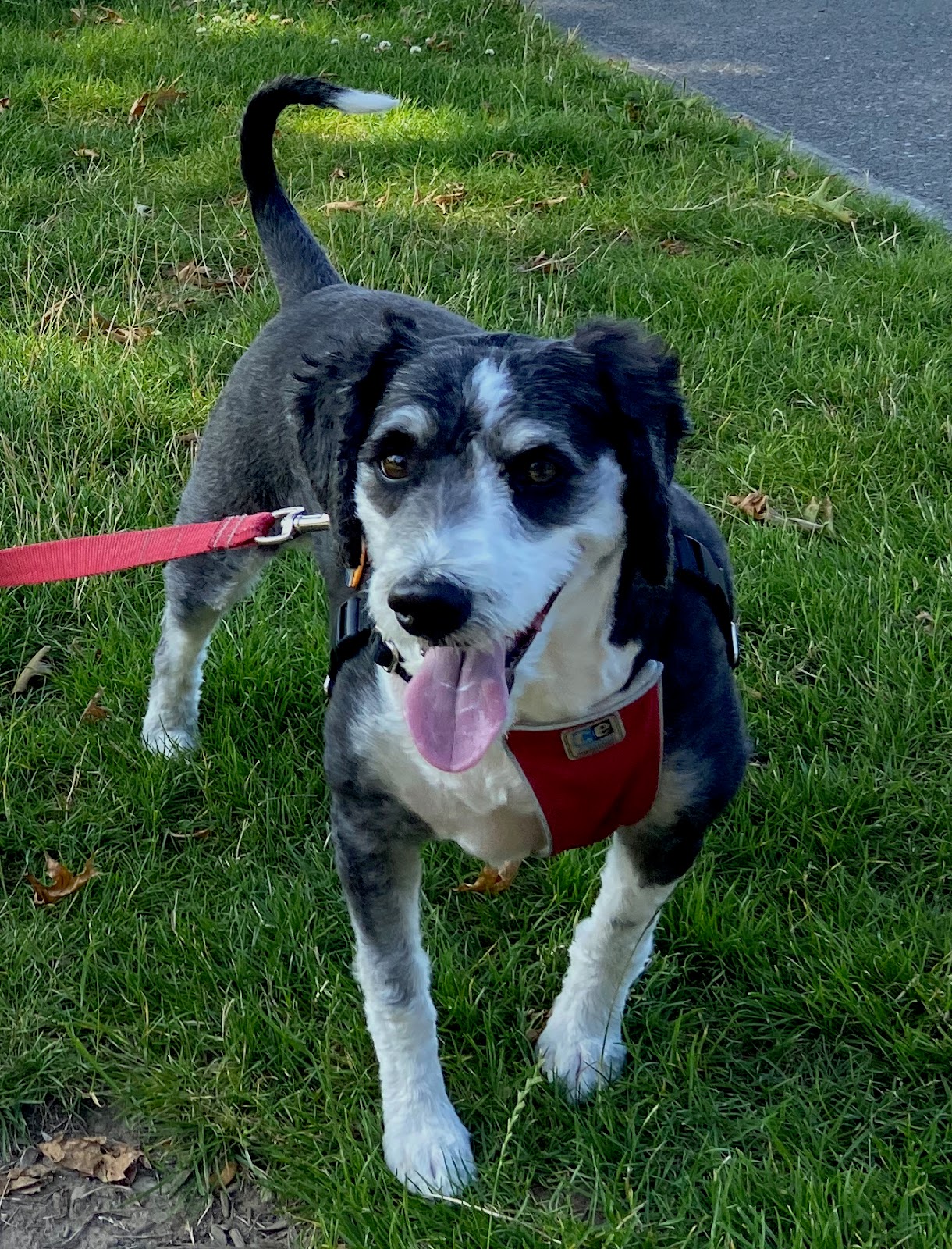


It’s been six years since my world turned upside down after abusive workplace dynamics triggered Post-Traumatic Stress Disorder. With the help of my healthcare providers and the support of the best family in the world, I’ve made immense progress with many of my debilitating symptoms


Nevertheless, I will never be “cured.” The stress and tics don’t go away. To the contrary, my trichotillomania and my stammer are worse than ever. Meanwhile, my mind has compensated for the vicious cycle of triggers and traumas by compressing four years of memories into two, as if the guys remodeling my brain poured the foundation off-kilter and the rest of us will have to compensate forever. (Silver lining:  for me the entire Trump presidency seems like just a couple of years.) 


Fortunately, more recently I’ve returned to the light. I’ve regained a hopeful mindset for the first time since childhood. And as I recently wrote in “Snap,” I’ve finally figured out how to slow down enough to think clearly. It involves a lot of long walks with Bear – which had the unfortunate side effect of crippling my right foot with plantar fasciitis. Now I just need to find a podiatrist who takes our terrible health insurance.
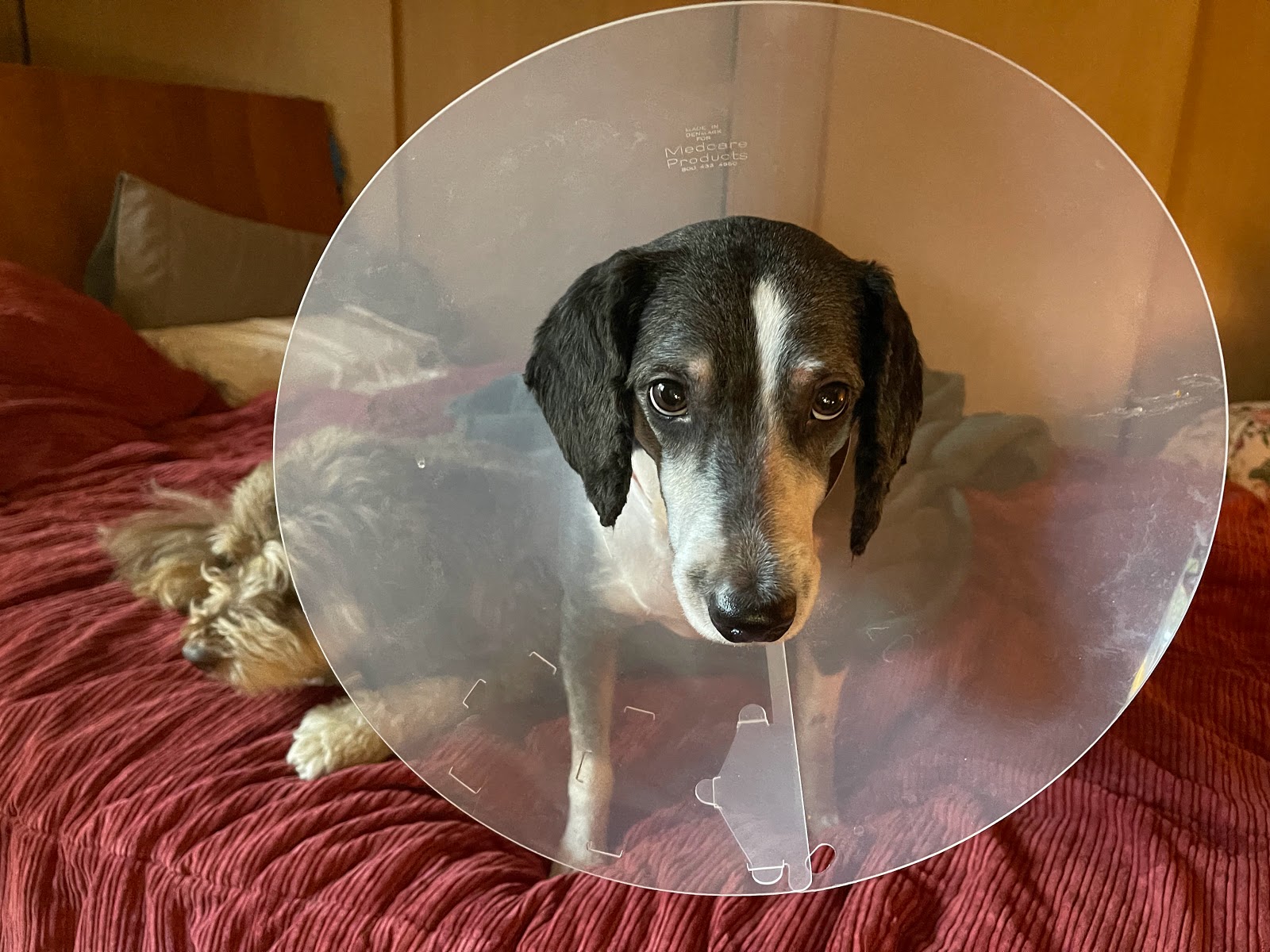


Over the last three years I found my personal Groundhog’s Day loop on my daily walks with Bear.


Many of my remaining challenges are social. Trauma had the effect of moving me several notches further away from “normal” on the autism spectrum – particularly during PTSD episodes, while under stress, and/or in my interactions with gay men. I’ve lost much of my already dubious ability to read ordinary social cues. Faces are a blank. Nowadays I can’t tell if someone is hitting on me or challenging me to a duel. Strangers overwhelm me. 


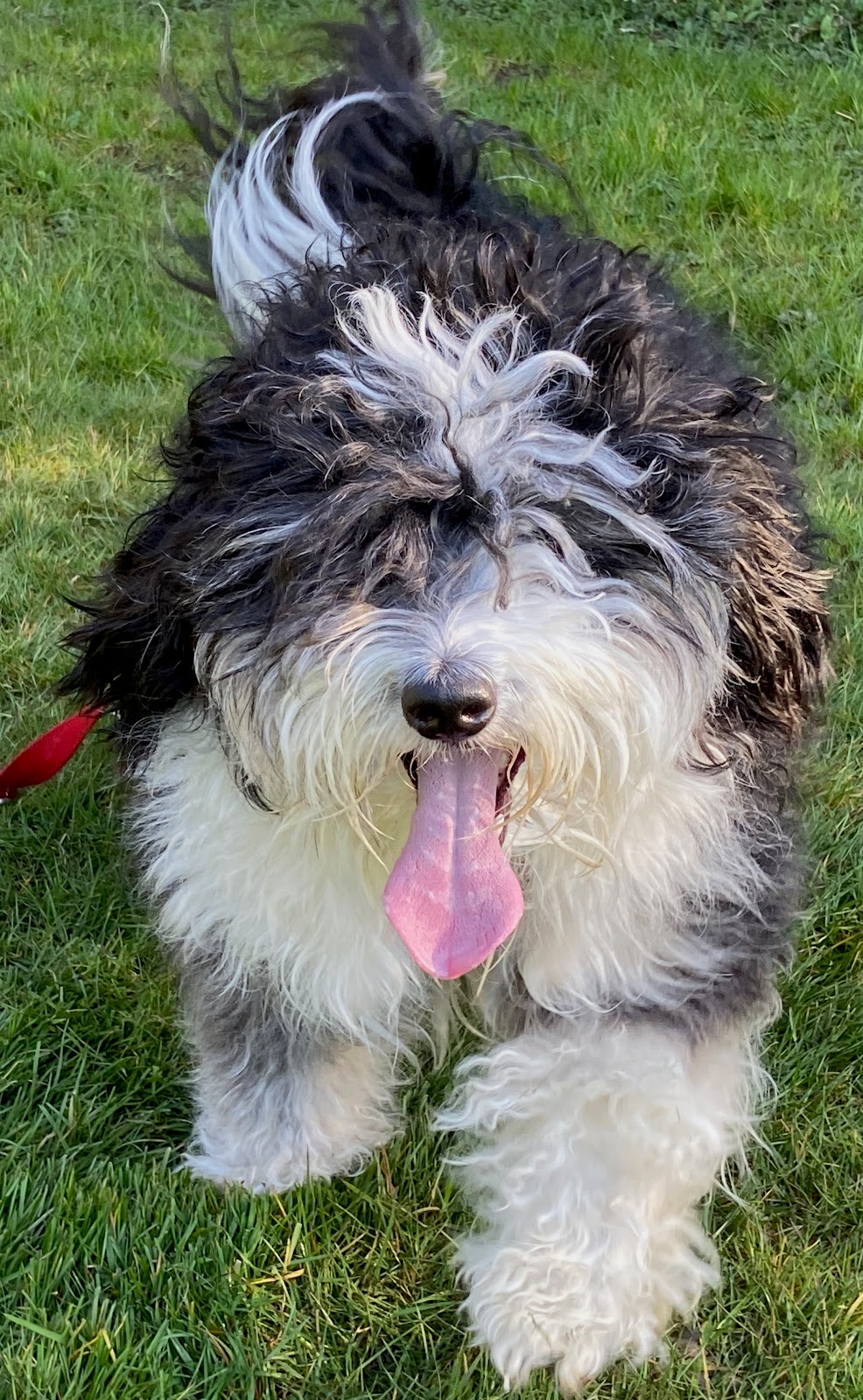
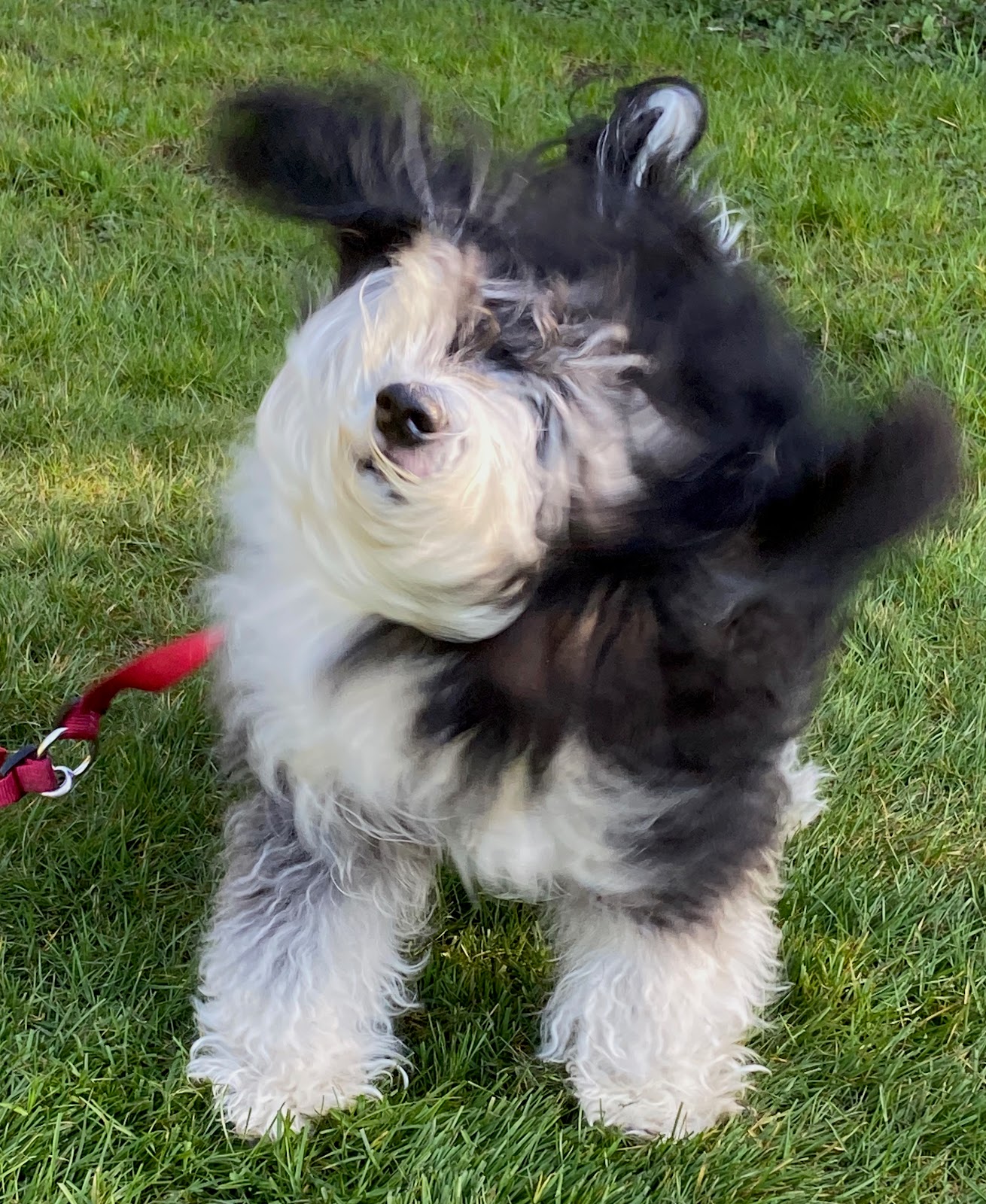
But as I walk along the waterfront trail with Bear, I have the opportunity to repeat the same social interactions over and over. I gracefully thank people who admire his pied beauty. I explain Aussiedoodles are a cross between Australian shepherds and poodles. I talk about the weather, and laugh politely when old men quip “Who’s walking who?” as if I’ve never heard the question before. 


In the beginning I couldn’t sustain a multi-sentence exchange, let alone a conversation. My attempts at humor fell flat and made me seem creepy. But dog people are nice, and you can talk to them about safe topics like de-worming medication and scheduling a groomer. Gradually I added new material. 


Last Saturday, Bear and I walked ten miles in the sunshine. I confidently risked social encounters with a high degree of difficulty. I even had the nerve to say something clever to the cute new guy at the coffee shop who is in the process of dethroning his charming co-worker from the position of Coffee Boy Crush. (I’m only allowed to have one Coffee Boy Crush at a time – a prudent rule imposed long ago in Chicago by my friend Charles.)


My one misstep occurred when I tried to strike up a conversation with a poodle owner wearing too many layers of fleece. I thought I was talking to a white-haired lesbian, but it turned out to be a little old man. Years ago I made the same mistake on my way home from the Gay Softball World Series when I stood in line behind diminutive gay comedian Leslie Jordan. 


Read “For Good,” my story about the dogs, 

in the recently published anthology True Stories Vol. IV


Last weekend I was one of the writers reading from our recent work at the launch of True Stories, a new anthology edited by Cami Ostman, founder of The Narrative Project. Here’s a link to the YouTube video (I’m reading from 35:35 to 39:25), and a link to the site where you can purchase copies of our book.


My contribution to True StoriesFor Good, ” comes from the chapter of my upcoming memoir where I explain that Im not really a dog person. Here’s an excerpt:


Bear is more attractive than anyone I’ve ever dated – way out of my league. As I walk past strangers on the waterfront trail, I often hear audible sighs of “Aw, he’s sooo cute.” Sadly, it’s never about me.


Nevertheless, the best thing about going on long walks with Bear every day is that everyone we encounter is smiling. Yes, I know they’re not smiling at me. But they’re smiling at us—and at everyone else for a little while. Surely that makes the world a slightly better place.


On our last walk along the Boardwalk, Bear asked if I planned on getting a new dog after he’s gone. I said no. I told Bear I would keep taking care of poor Buster if my daughter turned out to be a flake, but when it comes to pets I’ll stick with the fabulous gay uncle role in the future. Still, regardless of what happens in future, I know that having a dog—having Bear in my life—has changed me for good.
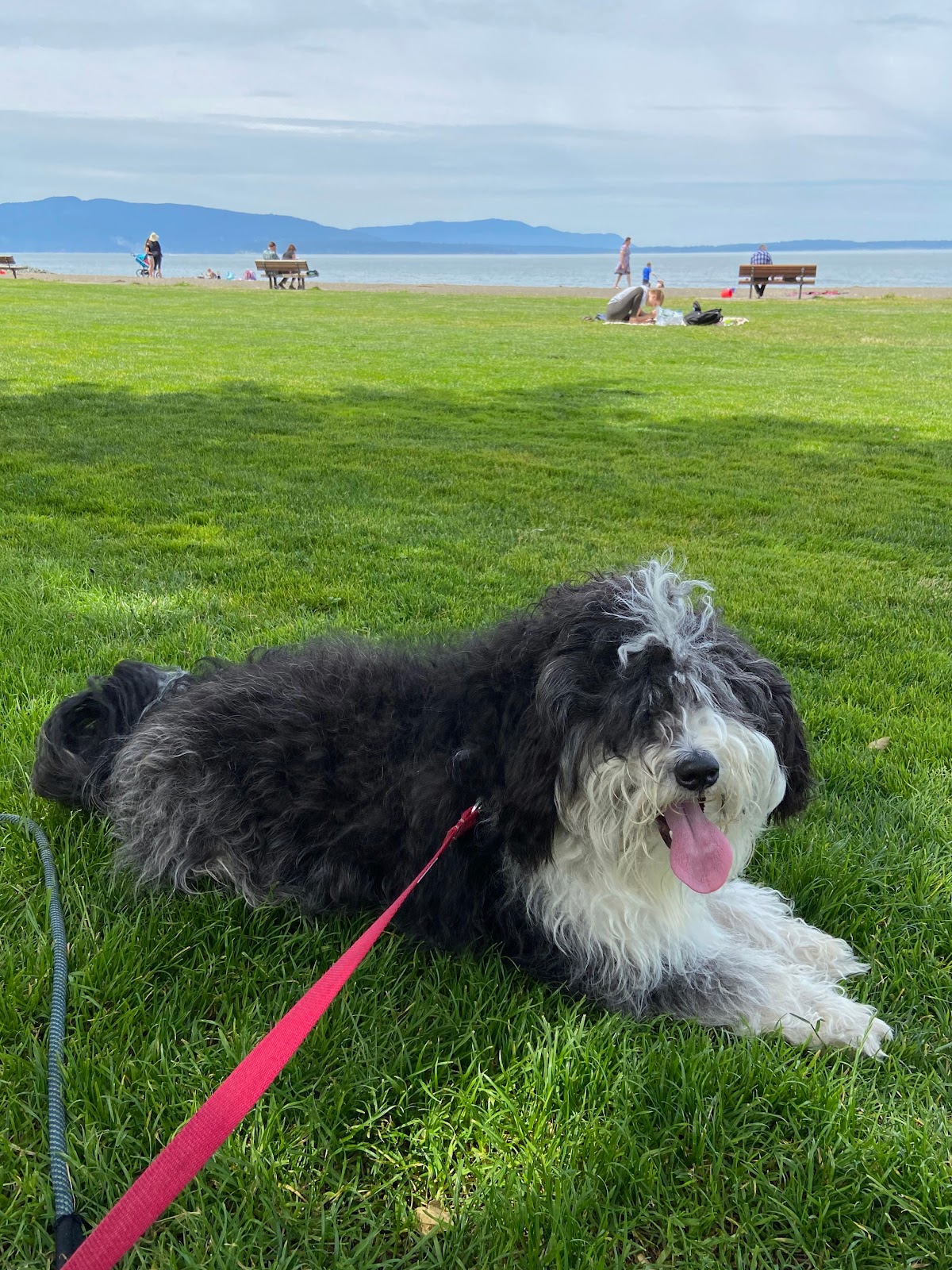


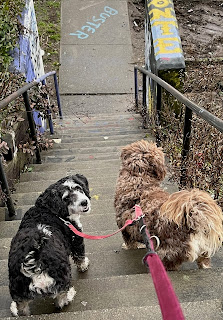
Which brings us to Buster, who has been conspicuously absent from his story so far.


This fall my middle brother and his wife became the first empty nesters from our generation. They immediately bought their first dog, an adorable Labradoodle named Scout who now dominates the family Facebook feed. 


I warned my brother he’s in danger of becoming a dog person permanently. Luckily, I acquired two dogs at once. Bear is the perfect companion for my life right now. In contrast, Buster is a constant reminder that lightning won’t strike twice.


Buster has more tics and is even more socially awkward than me. He steals underwear from the laundry basket and bloody tissues from my pocket, then eats them. He’s clumsy and stupid and a little bit racist. He hates going on walks. If Bear and I drag him along the trail with us, Buster just barks and walks into things before pooping out too soon. Buster’s highest and best use is to lounge on the couch and comfort my children. 
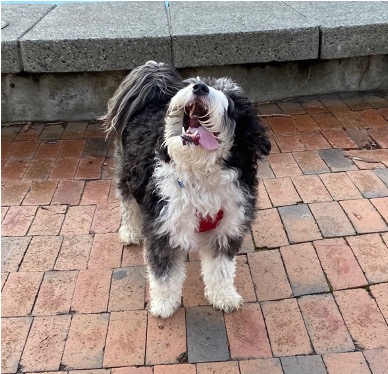


One day last summer, Bear and I begrudgingly included Buster in a necessarily short walk. On the Boardwalk we ran into my ex’s next ex Brenden. After they divorced, my ex moved back to the Midwest and I ended up with the kids fulltime. Plus Bear and Buster. 


Brenden still lives in Bellingham, but his work schedule prevented him from taking the dogs. Instead, he has embraced the guncle role with both children and dogs. The continued support of Brenden and his parents has been essential to the kids’ wellbeing during these challenging times. 


When we ran into Brenden on the Boardwalk, Bear pounced with typical enthusiasm. In contrast with his usual public awkwardness, Buster wildly embraced Brendon and smothered him with kisses. When Brenden continued in the other direction, Buster sat on the Boardwalk pining. He wouldn’t let us leave for thirty minutes, and instead stared longingly into the distance. I realized Brenden was the love of Buster’s life – and that traumatic experiences can shatter even a simple psyche.



Several businesses in Fairhaven identify as dog friendly and offer treats at the counter. If any merchant gives Bear a dog treat just once we can never walk past the doors of that establishment again without going inside. Ituncanny. Trading treats for hugs with Bear has become the highlight of the day for numerous Village Books employees. 


In contrast, dim-witted Buster approaches every gift of a dog treat like its his first time – a happy surprise.


Seasons and school calendars remind us life is cyclical. For people like Buster or Dr. Oliver Sacks’ amnesiac patients, each circle is the same. For others, like Phil Connors before the events of Groundhog Day, life is a downward spiral. Each February Phil would schlep to Punxsatawney, complaining bitterly about everything and everyone, and make every turn of the wheel worse than the one before. The opposite of a redemption story is a “contamination story.”


As I’ve slowly recovered my health over the last few years, I’ve also re-learned the power of positive thinking and hopeful living. In the best book I read last year, What are the Chances? Why We Believe in Luck, neuroscientist and statistician Barbara Blatchley writes 


When lucky people are unlucky – when something unwanted or awful happens – they learn from their mistakes, incorporating that experience into their expectations about the future. They are able to use their transformed expectations to change their bad luck into good for the next time.


Groundhog Day demonstrates the power of evolution:  not biologically as a species, but culturally as a community, and personally as individuals. Unlike Buster, we can choose to spiral upward.


Sunday, January 16, 2022

Snap


Last month both my mother and my daughter pointed out I was snapping my fingers as I talked. I hadn’t noticed.


Finger-snapping is a new addition to my repertoire of compulsive body tics. My right hand can snap pretty well, but because of my deformed thumbs it takes a few snaps to get my feeble left hand going – like a Boy Scout trying to start a fire in the rain.


The snapping started this fall, when lawyers for the State and its investigators began making particularly triggering new arguments. In the past, their lies merely caused me to compulsively leap out of my chair and pace ten or twenty laps around the house, grinding my teeth and rubbing my scalp rawNow when I pace I sometimes trace circles in the air with my snapping right hand. So far it’s happened in response to gaslighting assertions by four attorneys of widely varying skill but narrowly varying morals. I look like I’m casting a spell to ward off evil.


I recently wrote in “Stereotypos” about how our brains and our motor functions sometimes get their wires crossed. In Musicophilia: Tales of Music and the Brain, Dr. Oliver Sacks described professional musicians with Tourettes Syndrome who harness the energy fueling their tics and direct it toward their creativity. The next Sacks book I read was An Anthropologist on Mars, a collection of seven paradoxical tales of neurological disorder and creativity, including various savant artists as well as autistic animal husbandry expert Temple Grandin. One of Sack’s subjects is a successful surgeon with a private pilot’s license and severe Tourette’s Syndrome. Coincidentally, I read this paragraph about Dr. Bennett shortly after I observed my own finger-snapping phenomenon: 


Another expression of his Tourette’s – very different from the sudden impulsive or compulsive touching – is a slow, almost sensuous pressing of the foot to mark out a circle in the ground all around him. “It seems to me almost instinctual,” he said when I asked him about it. “Like a dog marking its territory. I feel it in my bones. I think it is something primal, prehuman – maybe something that all of us, without knowing it, have in us. But Tourette's ‘releases’ these primitive behaviors.”


Not a picture of me - my thumbs don't bend that way

In November I attended my first post-Covid in-person meeting at school. In the years since the last meeting, the topic “Learning Strategies” had been renamed “Executive Function.” Brain science is everywhere.


The evolutionary history of your brain can be compared to piling scoops of ice cream on a cone. At the bottom is the reptilian vanilla scoop of our brain stem. Even the simplest animal has a similar need for these neurons dedicated to basic life support and motor functions. Natural selection subsequently piled on extra scoops to handle our more sophisticated motor needs as mammals. Meanwhile, evolution added scoops of the fruity flavors that create, regulate, and respond to emotions. Perched precariously on top, at least for humans, is a final delicious scoop containing the revolutionary flavors of the prefrontal cortex, including Executive Function. 


According to Harvard’s Center on the Developing Child, “Executive function and self-regulation skills are the mental processes that enable us to plan, focus attention, remember instructions, and juggle multiple tasks successfully. Just as an air traffic control system at a busy airport safely manages the arrivals and departures of many aircraft on multiple runways, the brain needs this skill set to filter distractions, prioritize tasks, set and achieve goals, and control impulses.”


Nine months of gestation is not enough time to bake a human brain. Key functions like language and Theory of Mind take a few more years to develop. And as any neuroscientist or parent of teenagers can tell you, Executive Function is the last part of the brain to finish baking, hopefully by your early 20s. 


As I explained in “7-Eleven Law School is accredited,” every three years lawyers in Washington have to report they’ve attended 45 hours of Continuing Legal Education. Each month the state bar association offers a free lunchtime webinar. Brain science really is everywhere – in November our topic was “Productivity and ADHD in Law: Actionable strategies for overcoming intense productivity demands and finding balance”:


With billable hours, meeting deadlines, compliance requirements, documentation, and stressful communication, attorneys face intense productivity demands every day. Many attorneys are also struggling with some type of executive function challenge: focusing, staying on task, organizing, managing time effectively, starting and finishing tasks, keeping a schedule, communicating with others, and more. Attorneys with ADHD and other forms of neurodiversity may have additional obstacles related to executive function. 


The good news is that there are proven strategies that individuals and teams can use to increase productivity, decrease burnout, and create inclusive workplaces. Paige Porter from The How Skills will be sharing actionable approaches that have been effective for thousands of professionals working in the legal profession and beyond. 


The excellent presenter outlined a series of “strategies to help neurodiverse attorneys—or anyone experiencing Executive Function challenges—to improve the way they work.”


I don’t have Attention-Deficient / Hyperactivity Disorder. But as I listened to the presentation, I had an epiphany. The neural networks in our prefrontal cortex that give us our capacity for Executive Function were the last parts of the human brain to evolve. They are the last part of a child’s brain to develop. For the rest of our lives, Executive Function remain vulnerable to all kinds of assaults. In my case, both ordinary stressors and specific PTSD triggers easily impair my Executive Functioning.


Another term for “Executive Function” is “Attention.”


In his classic book Thinking, Fast and Slow, Nobel-laureate Danial Kahneman outlined an influential model of brain function. The “fast” and “slow” thinking in Kahneman’s title refers to the human brain’s revolutionary double processor. What Kahneman calls System 1 is the ultimate in animal brains. It’s programmed to perform tasks like initiating a fight or flight, tying shoelaces, and falling in love. System 1 “operates automatically and quickly, with little or no effort and no sense of voluntary control.” It can conduct numerous tasks simultaneously, including monitoring events, detecting threats and opportunities, retrieving memories, making associations, and leaping to generally correct conclusions.


According to Kahneman, humanity’s big brain breakthrough occurred when evolution integrated the automatic processes of System 1 with a second mental processor that is capable of Executive Function. System 2 “allocates attention to the effortful activities that demand it, including complex computations. The operations of System 2 are often associated with the subjective experience of agency, choice and concentration.” System 2 is very powerful, but it has limited capacity and rapidly depletes energy.


I’ve learned to reduce the impact of my compulsive tics by distracting my hands with soothing fidget toys. It turns out I get the best results with promotional sample cuttings from the innards of Purple® mattresses. Whenever anyone in our family drives through Lynnwood, they drop by the Purple store in Alderwood Mall to pick up more samples.


After my mother observed me compulsively snapping my fingers, she sighed and went upstairs to her secret stash of purple unfuzzy things. (Some people interpret sighs as “No you can't have another one.” I hear “I love you.”)


Still, why do I keep losing my purple fidget things? Because I can’t see them.


[Spoiler alert – don’t read any further if you want to be a test subject in the most famous psychology experiment of the last three decades.] 


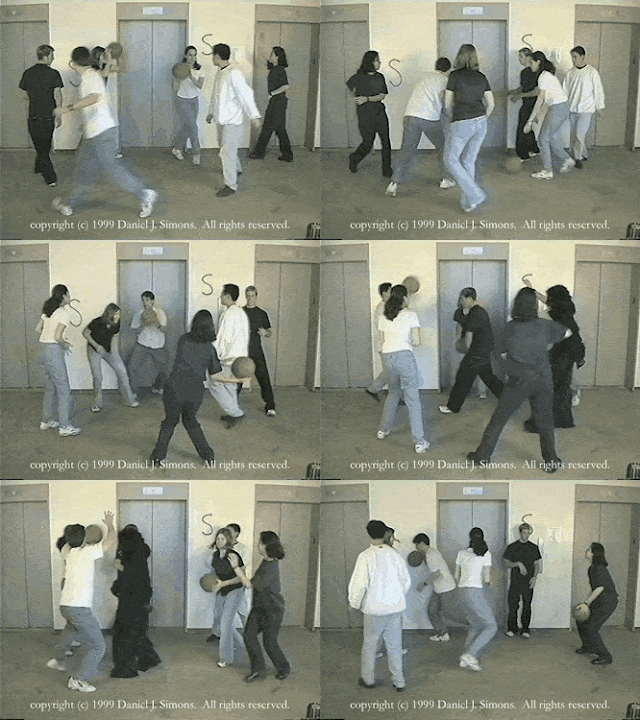
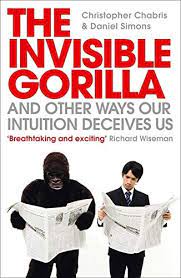
Daniel Simons of the University of Illinois and Christopher Chablis of Harvard received an igNobel award for their study design. I took their test years ago in Scotsdale, Arizona, as part of another legal education presentation. We were asked to watch a short video of two basketball teams and count the number of times a member of the white-shirted team touched the ball.


I correctly counted the number of touches. But, like a majority of test subjects, I didn’t notice the man in a gorilla suit who walked through the players while my attention was focused on counting.


Although evolution gave us uniquely powerful brains, real life often makes demands that exceed the capacity of human hardware or software. Fortunately, human intelligence learns to work around many of our biases and blind spots. For example, because of the location of the optic nerve, the visual data coming to our brains has a literal blind spot right in the middle of our visual field. The punctum caecum should always appear in front of you as a black circle bigger than the moon. But our brain’s visual systems and circuits eventually figured out a way to fill in the missing information without the rest of our brain noticing. That’s how non-Artificial Intelligence works. 


I thought about the gorilla and the retinal punctum caecum blind spot last month as I struggled to tie Bear’s poop bag with one hand. Then I remembered Bear was off leash. I wondered why I was trying to tie a one-handed knot with my feeble semi-opposable left thumb. 


Suddenly I saw my right hand, right there in the center of my field of vision. It was fiercely squeezing a purple unfuzzy thing.


Cognitive bias is like an optical illusion. With some illusions your vision immediately clears once you learn the secretThe gorilla video doesn’t work on me anymore. 


Other kinds of blindness, like my invisible right hand holding an unfuzzy thing, or like Yanni/Laurel and the blue/gold dress, apparently will fool and divide most people forever. For these cognitive challenges we must invent compensations and circumventions, or seek accommodations.


Always remember bias is a feature of the amazing human brain, not a bug. Our “heuristics or automated cognitive shortcuts work most of the time, from Ockham’s Razor to Hanlon’s Law to gaydar. Heuristics – biases – KahnemanSystem 1 – make it possible for our very human brains to think without blowing circuits all the time. As a consequence, the ongoing challenge for each of us is determining how much of our precious Attention we should devote to dispelling the illusions we inevitably encounter.


Cognitive Bias Codex

When I was in private practice, I often wished Id minored in psychology. As a litigator, every client with a legal problem was also dealing with anxiety, depression, grief, or trauma. I would have benefited from a counselor’s skills. 


After I was diagnosed with PTSD, I assigned myself a reading and writing list that resembles a graduate degree in psychology and neuroscience. My particular interests include how humans think and make decisions. So I was impressed this summer when the presenter during our lunchtime Continuing Legal Education webinar about effective negotiation skills included a picture of the beautiful “Cognitive Bias Codex,” and a link to its designers website. Someone with OCD created a taxonomy from all 182 Wikipedia entries identifying individual cognitive biases. Then a graphic designer made it pretty. The primary quadrants:  (1) “Too much information”; (2) “Not enough meaning”; (3) “Need to act fast”; and (4) “What should you remember?”  


When I first clicked on the Cognitive Bias Codex link,  I was overwhelmed. But when I drilled down to examine the individual descriptions of fallacious reasoning, I realized I’d already figured out effective work-arounds for many common cognitive biases. I’ve written about Hasty Generalizations and “Begging the Question,” and faced down Codependency. Sometimes the best response to a preposterous cognitive Boggart is the incantation “Riddikulus!”


As I wrote in an early essay about “Confirmation Bias,” I found this cartoon on a legal blog named “Persuasive Litigator,” in a post by Dr. Ken Boda-Bahm called “Fight Confirmation Bias:  Consider the Opposite.” Dr. Boda-Bahm points out that part of the power of confirmation bias is that it “protects and perpetuates itself.” We see this phenomenon with “fake news”:  in the attempt to debunk a falsehood, often you merely reinforce the original lie in the minds of listeners. Asking jurors or listeners to be “fair and impartial” is not enough.

However, there’s one technique that has been proven to dispel confirmation bias:  “consider the opposite,” i.e., put aside your initial conclusion and methodically list the evidence and arguments supporting the opposite result. According to Dr. Boda-Bahm, asking decision-makers “to imagine that the results pointed in the opposite direction apparently encourages them to think about how they are processing the information, and that works against the bias.” 


I had the opportunity to observe the power of both confirmation bias and “considering the opposite” during a recent Zoom oral argument. We had an ice cold bench – the judge didn’t ask a single question to either lawyer. After counsel sat down, the judge announced his ruling. Although our busy trial court judge obviously hadn’t read the briefs closely, he was very prepared to dismiss my mandamus claim against the State bureaucrat who refused to file ethics claims identifying the illegal use of public resources by her own co-workers and supervisors. 


The Court didn’t refer to any particular case in its ruling, only to the general rule that mandamus relief doesn’t apply to “discretionary” acts. (My Response Brief cited seven Washington cases holding that it doesn’t take “discretion” for a bureaucrat to check whether a citizen filing includes all the information explicitly required by a statute or rule; both their Motion and Reply instead cited to an inapplicable federal death penalty case). 


The only statutory provision the judge mentioned wasn’t cited by either party in their briefs. It appears in a different part of the Ethics in Public Service Act, and involves what happens when the staff accepts an ethics complaint but doesn’t bother to do an investigation. Not coincidentally, in preparing for oral argument the day before I happened to have researched the entire legislative history of the sentence the judge quoted – because I know the best way to determine if you’re only seeing one side of a problem is to assume the other side’s position is correct and identify all the arguments and evidence supporting it. The statutory sentence the judge cited was the best thing I could come up in support of the State’s position, too.


One sign of cognitive bias is when you grasp at increasingly implausible motes, and ignore all the actual beams in your eye. Fortunately, when Executive Function approaches a problem with something like the scientific method – asking yourself how the evidence contradicts rather than supports your initial hypothesis – human Attention can overcome the effects of confirmation bias and other cognitive blind spots. 


When I look at the Cognitive Bias Codex now, I see a beautiful flower; and a human brain; and how thinking works. It’s a snap. 


Tuesday, January 4, 2022

Another Do-Over Year

2022  많이 받으세요
“2022nyun bok manhi padeseyo”

The literal translation of the Korean equivalent to “Happy New Year” is “May you receive many blessings in 2022.”


Hopefully a few new blessings.


2021 turned out to be another year spent indoors waiting for viruses, lawyers, and judges to finish their work. I didn’t see enough movies to generate a list of favorite films. The only play I saw indoors was a high school production of Macbeth (Eleanor was one of the witches). My only other non-Zoom experience was seeing David Sedaris at the Mount Baker Theatre in September.


Fortunately, one of the benefits of emerging from the fog of mental illness is that I’m reading again. In addition to magazines and other online reading, last year I finished sixty books. Here are my favourites: 


Roger's Favourite Books of 2021


1.     Barbara Blatchley, What are the Chances? Why We Believe in Luck


2.     Vladimir Nabokov, Speak, Memory


3.     Lauren Hough, Leaving Isn’t the Hardest Thing


4.     Lacy Crawford, Notes on a Silencing


5.     Temple Grandin, Animals Make Us Human


6.     Sarah Schulman, Let the Record Show:  A Political History of ACT UP New York 1987-93


7.     Stephen King, On Writing


8.     Oliver Sacks, On the Move


9.     Douwe Draaisma, Why Life Speeds Up As You Get Older: How Memory Shapes Our Past


10.  B.J. Fogg, Tiny Habits


11.  Daniel J. Levitin, This is Your Brain on Music


12.  Leslie Jamison, The Empathy Exams


13.  Maria Konnikova, The Biggest Bluff: How I Learned to Pay Attention, Master Myself, and Win


14.  Brian Greene, Until the End of Time


15.  Michael Shermer, The Believing Brain


16.  Leonard Mlodinow, The Drunkard’s Walk:  How Randomness Rules our Lives


17.  Eric Garcia, We’re Not Broken:  Changing the Autism Conversation


18.  Sam Quinones, The Least of Us: True Tales of America and Hope in the Time of Fentanyl and Meth


19.  David Sedaris, A Carnival of Snackery: Diaries (2003-2020)


20.  Simon Garfield, Dog’s Best Friend


21.  Anne Lamott, Bird By Bird


22.  Michael J. Fox, No Time Like the Future


23.  Julia Glass, A House Among the Trees


24.  Kevin Kwan, Crazy Rich Asians


25.  Oliver Sacks, Hallucinations


26.  Daniel Kahneman, Olivier Sibony, & Cass Sunstein, Noise: A Flaw in Human Judgment


27.  Alan Cumming, Baggage


28.  Ethan Kross, Chatter: The Voice in Our Head, Why it Matters, and How to Harness It 


29.  Daniel J. Levitin, The Organized Mind: Thinking Straight in the Age of Information Overload


30.  Stephen Hawking & Leonard Mlodinow, The Grand Design


I’m fascinated by memoirs, both as a reader and a writer. My 2021 reading list included memoirs by writers, mathematicians, neurologists, addicts, and actors, as well as dispatches from across the Autism Spectrum. Plus Vladimir Nabokov. Many English Majors identify Speak, Memory as the best-written memoir ever. It’s true – the rest of us should probably just give up writing. But we can’t help ourselves.


Upcoming blog essays respond to the two memoirs that spoke most directly to me in 2021. Lacy Crawford is a journalist. In Notes on a Silencing, Crawford describes her trauma as a sexual assault victim at a prestigious boarding school, and her triggers and re-traumas three decades later as she observed how the legal system worked to protect her abusers and their enablers.


Lauren Hough is a middle-aged lesbian writer/cable installer whose parents raised her in a weird sex cult named “The Children of God.” Leaving Isn’t the Hardest Thing tells how Hough escaped her religious roots by finding a new community in the military – only to find herself betrayed by authoritarian abusers in the era of “Don’t Ask, Don’t Tell.” It turns out Pharisees and lawyers are everywhere.


As usual, many of the other books on my 2021 reading list are about how thinking does and doesn't work.


Other than our extraordinary brains, humans are unremarkable as a species. Many animals are faster and stronger, with superior powers of vision and hearing, or superpowers like flight and invisibility. Instead, after our primate ancestors diverged from their chimpanzee cousins, evolution spent the next sixteen million years focused on building bigger and fancier human brains. This turned out to be a great longterm investment – eventually. 


In the meantime, we spent most of the Pliocene and Pleistocene eons as feeble hairless bipeds cowering in trees and caves. Even after the arrival of modern Homo sapiens half a million years ago, we lived for hundreds of thousands of years scattered in small bands of hunter-gatherers, well down the food chain from more impressive predators. Even within genus Homo, H. sapiens isn't very special. To the contrary, just 100,000 years ago we were one of at least six extant human species. Even after we tamed fire and invented a few stone tools, the investment in big brains was hardly paying dividends. As Yuval Noah Harari points out


We assume that a large brain, the use of tools, superior learning abilities and complex social structures are huge advantages. But humans enjoyed all of these advantages for a full two million years during which they remained weak and marginal creatures.


Then, just a few thousand years ago, something clicked in the human brain. Suddenly we experienced an accelerating series of revolutions:  agriculture, writing, civilization, empires, industry, automobiles, and iPhones. In a cosmic blink of the eye, humans achieved supremacy over every other species on the planet. 


Since this Cognitive Revolution, there hasn’t been enough time for natural selection to accomplish further genetic evolution. Instead, our enhanced human brains are responsible for the havoc wrought by the immense cultural evolution that continues at an ever-accelerating pace. At our current rate of “progress,” well only need a few centuries or even mere decades before we join Tyrannosaurus Rex and the dodo in extinction, no doubt dragging the rest of the biosphere with us. Unless we finally learn how to think clearly.


For decades, evolutionary biologists and child psychologists have been trying to figure out when the human mind originated. Both point to the same breakthrough in the development of the human species and in the development of each human individual child:  “Theory of Mind.” 


The phrase “Theory of Mind” comes from an influential 1978 paper by David Premack and Guy Woodruff, “Does the chimpanzee have a theory of mind?” Only modern Homo sapiens has demonstrated the capacity to understand our experience and to act based on the proposition that other individuals possess a mental state that may differ from our own. When humans finally evolved enough to feel empathy, our brains grow three sizes. Not just our hearts.


Some neuroscientists and philosophers focus on another important aspect of Theory of Mind:  because each individual’s mental state is independent of the real world, humans can feel, believe, and foresee things that are not true and may never be. According to Harari, “large numbers of strangers can cooperate successfully by believing in common myths.”


One of the few TV shows I binge-watched in 2021 was The Wheel of Time, a sorta-feminist variation on Game of Thrones set in a fantasy world that resets itself every few thousand years. Human experience In the real world is profoundly cyclical, whether you focus on days, months, seasons, years, or the school calendar. 


Last year I read several excellent books about how our brains process probabilities, choices, disappointment, and uncertainty. My upcoming blog essay “How Lucky Can You Get?” dives into these topics, including some of the insights from my favourite book of the year, What are the Chances? Why We Believe in Luck, by neuroscientist Barbara Blatchley.


Blatchley identifies our reliance on “counterfactuals” as another important aspect of Theory of Mind:  


Counterfactuals are alternatives to reality that we generate, particularly after negative events. An upward counterfactual is an imagined alternative to reality that is better than what actually happened. A downward counterfactual is an alternative that is worse than reality. Researchers have found that upward counterfactuals might help us prepare to encounter this negative situation again in the future and perhaps to do better the next time.


What are the Chances? resonated with the best book I read in 2019, Carol Dweck’s Mindset. Dweck is the psychologist who coined the terms “fixed” and “growth” mindsets:

 
In a fixed mindset students believe their basic abilities, their intelligence, their talents, are just fixed traits. They have a certain amount and that’s that, and then their goal becomes to look smart all the time and never look dumb. In a growth mindset students understand that their talents and abilities can be developed through effort, good teaching and persistence. They don’t necessarily think everyone’s the same or anyone can be Einstein, but they believe everyone can get smarter if they work at it. 


Similarly, Blatchley observes “When lucky people are unlucky – when something unwanted or awful happens – they learn from their mistakes, incorporating that experience into their expectations about the future. They are able to use their transformed expectations to change their bad luck into good for the next time.” Life becomes an upward spiral.


Somehow we all made it through 2020 and 2021, endured Donald Trump and Zoom school, and survived forest fires and floods. Now it’s another new year. The holiday snow is melting and the days already feel longer. As we slouch toward Groundhog’s Day, remember the lesson of the classic 80s movie:  Bill Murray learned how to learn from experience.


According to Barbara Blatchley in What are the Chances?


Luck is the way you face the randomness in the world. If we are open to it, accepting, not anxious or afraid, willing to learn from mistakes and to change a losing game, we can benefit from randomness. We can gain a modicum of control over this aspect of life, even if we can't control the universe on a large scale. Randomness will happen no matter what we do—chaos theory rules in our universe. Knowing how to roll with the punches; now that's lucky.


May we all plant plenty of flowers and find many blessings in 2022.